How to Understand Tokamak Physics: Plasma Confinement and Magnetic Fields
The tokamak is the leading fusion device design, using magnetic fields to confine plasma at 150 million degrees — 10x hotter than the Sun's core. This guide covers plasma physics, magnetic confinement, and key parameters.
Introduction
The tokamak is the leading fusion device design, using magnetic fields to confine plasma at 150 million degrees — 10x hotter than the Sun's core. This guide covers plasma physics, magnetic confinement, and key parameters.
Prerequisites
- ✓ Basic electromagnetism
- ✓ Thermodynamics concepts
- ✓ Nuclear physics basics
- ✓ Calculus helpful
Key Concepts
Step-by-Step Guide
- 1
Understand Fusion Reactions
Fusion combines light nuclei, releasing energy (E=mc²). The most accessible reaction is D-T: Deuterium + Tritium → Helium-4 (3.5 MeV) + Neutron (14.1 MeV). D is abundant in seawater; T is bred from lithium. The 14 MeV neutron carries 80% of energy and must be captured in a blanket.
textD-T Fusion: ²H + ³H → ⁴He (3.5 MeV) + n (14.1 MeV) Total: 17.6 MeV per reaction Temp needed: ~150 million K Energy/g D-T: 3.4×10¹¹ J (8M× coal) - 2
Master Plasma Physics
At 150M K, hydrogen is fully ionized — a plasma of protons and electrons governed by magnetohydrodynamics (MHD). Key: quasi-neutrality, collective behavior, Debye shielding. Fusion plasma density ~10²⁰/m³ — about 10⁶ times less dense than air. Energy comes from temperature, not density.
Tip: Fusion plasma is one-millionth of atmospheric density. The energy comes from extreme temperature (150M K), not density. This is why magnetic confinement works — plasma pressure is manageable. - 3
Understand Magnetic Confinement
Charged particles spiral around magnetic field lines (Larmor orbit). Toroidal field coils create a field around the torus; plasma current creates a poloidal field. The combination produces helical field lines that confine particles. Without the poloidal field, particles drift outward due to field gradient and curvature.
Warning: Magnetic confinement is never perfect. Particles drift across field lines due to collisions, turbulence, and MHD instabilities. Energy confinement time is typically 0.1-3 seconds. Improving confinement is the central challenge. - 4
Learn the Lawson Criterion
The Lawson criterion: n·T·τ > 3×10²¹ keV·s/m³ for D-T fusion at T~15 keV. You need high density, high temperature, and long confinement time. ITER targets n·T·τ ≈ 3×10²¹ for Q=10.
textLawson Criterion (D-T): n·T·τ > 3×10²¹ keV·s/m³ n: ~10²⁰ m⁻³, T: ~15 keV, τ: ~3 s ITER: Q=10, JET record: Q=0.67 Ignition (Q=∞): n·T·τ > 5×10²¹ - 5
Understand Tokamak Components
Key systems: 1) Toroidal field coils (18 in ITER) — main confining field, 2) Central solenoid — induces plasma current, 3) Poloidal field coils — shape and position plasma, 4) Vacuum vessel, 5) Blanket — captures neutrons, breeds tritium, 6) Divertor — exhausts heat and helium ash, 7) Heating systems (NBI, ICRH, ECRH).
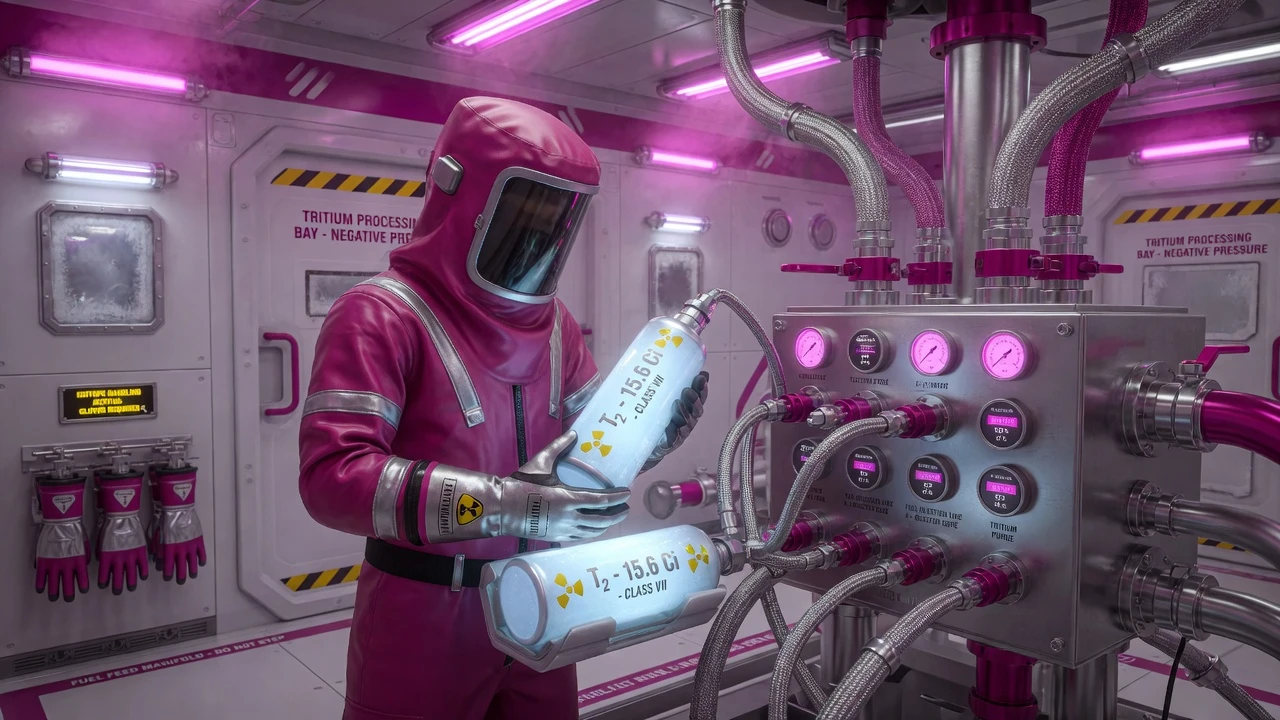
ITER toroidal field coils under construction — each weighs 360 tons, carries 68 kA to generate the confining magnetic field. - 6
Master Plasma Heating
Ohmic heating is insufficient. Three auxiliary methods: NBI (neutral beam injection), ICRH (ion cyclotron RF), ECRH (electron cyclotron RF). ITER: 50 MW heating for 500 MW output. Alpha particle self-heating becomes dominant at Q>5.
Tip: Alpha heating is key to ignition. D-T reactions produce 3.5 MeV alphas that deposit energy in the plasma. At Q>5, alpha heating exceeds external heating. At ignition, alpha heating alone sustains the plasma. - 7
Understand MHD Instabilities
Key instabilities: kink modes (current-driven), ballooning modes (pressure-driven), tearing modes (magnetic reconnection), ELMs (edge bursts that can damage the divertor). Stability controlled by plasma shaping, current profile, and active feedback coils.
Warning: ELMs are a major concern for ITER. Type I ELMs deposit several MJ in milliseconds on the divertor — potentially causing material damage. Mitigation: pellet injection, RMP coils, or ELM-free regimes. - 8
Learn Transport and Confinement
Energy confinement τ is set by transport: classical (collisional), neoclassical (toroidal effects), anomalous (turbulence — dominates, 10-100x higher). H-mode reduces edge turbulence, improving τ by 2-3x. ITER98y2 scaling: τ ∝ I^0.93 × B^0.15 × n^0.41 × P^-0.69 × R^1.97.
textITER98y2 H-mode Scaling: τ_E = 0.056 × I_p^0.93 × B_t^0.15 × n^0.41 × P^-0.69 × R^1.97 × κ^0.78 Key: bigger R and higher I_p improve confinement most. - 9
Understand the Divertor
The divertor is the plasma exhaust — handles heat, particles, and impurities. Magnetic fields channel plasma edge to strike points on target plates. Heat flux can exceed 10 MW/m² steady-state. Materials: tungsten (high melting point, low tritium retention). ITER: 54 cassettes, water-cooled.
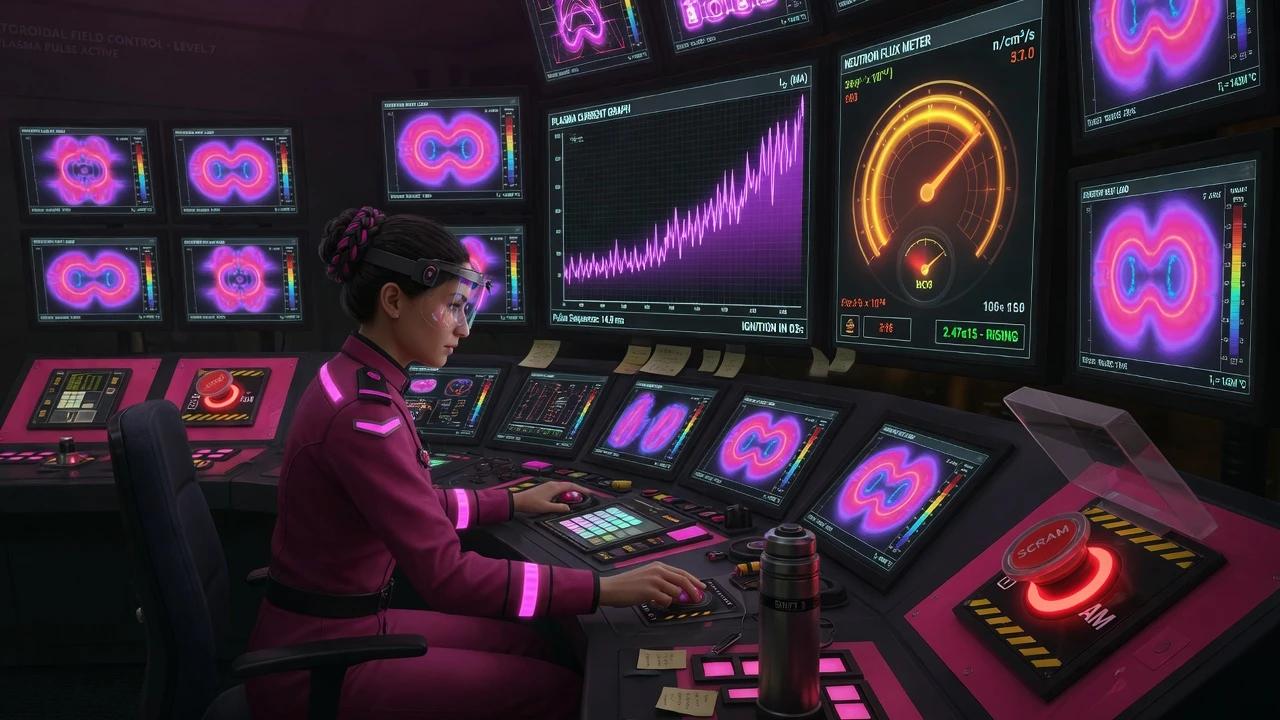
Tokamak control rooms monitor hundreds of plasma parameters in real-time — equilibrium, temperature, density, and stability. - 10
Study Key Experiments
ITER (France, 500 MW, Q=10, first plasma 2034), JET (UK, Q=0.67 record), KSTAR (Korea, 30s H-mode), EAST (China, 100s H-mode). Private: CFS SPARC (HTS magnets, Q>1 by 2027), Tokamak Energy (spherical tokamak + HTS).
Tip: HTS magnets (REBCO, 20+ T) enable compact tokamaks. CFS SPARC achieves ITER-equivalent performance at 1/40 the volume. Fusion power scales as B⁴ — doubling field gives 16x more power. - 11
Project the Path to Fusion Power
ITER first plasma 2034, D-T 2039, Q=10. CFS SPARC Q>1 by 2027, ARC power plant 2030s. First fusion power plant likely 2045-2055. Key milestones: sustained Q>1, tritium self-sufficiency, steady-state operation, net electricity. Key risk: ITER delays could push timeline 5-10 years.
Warning: Fusion timelines are notoriously optimistic. ITER was originally 2016 first plasma — now 2034. Private timelines (CFS 2027) are more credible but still ambitious.
Summary
The tokamak uses toroidal and poloidal magnetic fields to confine plasma at 150M K. The Lawson criterion (n·T·τ > 3×10²¹) defines minimum conditions for net energy. Key physics: MHD instabilities, anomalous transport, H-mode confinement. ITER (Q=10) is the flagship; HTS magnets enable compact tokamaks (CFS SPARC). Challenges: ELMs, divertor heat flux, tritium breeding, steady-state. First power plant: 2045-2055.
Frequently Asked Questions
The Coulomb barrier — electrostatic repulsion between nuclei — must be overcome. At 150M K, particles have enough kinetic energy to tunnel through via quantum tunneling. D-T has the lowest barrier, making it the most accessible reaction.
Tokamaks use plasma current for poloidal field (simpler, higher performance, but susceptible to disruptions). Stellarators use external coils only (no current, inherently steady-state, but complex 3D coils and slightly worse confinement).
Q is fusion gain — ratio of fusion power to heating power. Q=1 is breakeven, Q=10 is ITER target, Q=∞ is ignition (self-sustaining). Net electricity requires Q>5-10 due to efficiency and conversion losses.
ITER Q=10 in 2040s. First DEMO power plant 2045-2055. Commercial plants 2055-2065. Private companies (CFS) aim for 2030s-2040s but face engineering challenges beyond Q>1.
Test Your Knowledge
1. What is the Lawson criterion for D-T fusion?
The triple product of density, temperature, and confinement time must exceed 3×10²¹ keV·s/m³. This ensures more fusion reactions occur than energy is lost to transport.
2. Why does a tokamak need plasma current?
The plasma current creates the poloidal field, producing helical field lines that properly confine particles. Without it, particles drift outward due to toroidal field curvature.
3. What is H-mode?
H-mode forms a transport barrier at the plasma edge, suppressing turbulence and improving confinement 2-3x. Most modern tokamaks operate in H-mode.