How to Understand Reusable Rocket Economics: From $10,000/kg to $200/kg
Reusable rockets have reduced launch costs by 90%, transforming the economics of space. This guide explains the engineering, economics, and future trajectory of reusable launch vehicles.
Introduction
Reusable rockets have reduced launch costs by 90%, transforming the economics of space. This guide explains the engineering, economics, and future trajectory of reusable launch vehicles.
Prerequisites
- ✓ Basic physics (kinematics, orbital mechanics)
- ✓ Understanding of rocket equation concepts
- ✓ General knowledge of aerospace engineering
Key Concepts
Step-by-Step Guide
- 1
Understand the Cost Revolution
Before reusability, launch costs were ~$10,000/kg to LEO (Space Shuttle). Falcon 9 reduced this to ~$2,700/kg. With booster reuse (10+ flights), costs approach $1,500/kg. Starship targets $200/kg initially, potentially $50-100/kg at scale. This 100x reduction transforms what is economically viable in space.
textLaunch Cost Evolution (per kg to LEO): Space Shuttle (1981): $54,500 Delta IV Heavy: $13,000 Falcon 9 (expendable): $2,700 Falcon 9 (reused): $1,500 Starship (target): $200 Starship (scale): $50-100 - 2
Learn the Physics of Recovery
Recovering a rocket stage requires: decelerating from ~6,000 km/h to 0, managing thermal loads during reentry, and landing precisely. SpaceX uses: grid fins for aerodynamic steering, retropropulsion (burning engines backward) for deceleration, and landing legs for final touchdown. The booster performs a boostback burn (to reverse trajectory), entry burn (to slow for atmospheric entry), and landing burn.
Tip: Retropropulsion is the key innovation — previous reusable concepts (DC-X, VentureStar) used different approaches that proved impractical. - 3
Analyze Booster Reuse Economics
A Falcon 9 booster costs ~$40M to manufacture. With 15 reuses, the per-flight hardware cost drops to ~$2.7M. However, refurbishment costs ~$1-3M per flight. Total per-flight cost with reuse: ~$15M (vs $62M expendable). The economics improve with higher reuse counts and lower refurbishment costs.
Warning: Refurbishment costs are often underestimated. Early Falcon 9 reuses required significant engine inspections and replacements. As of 2026, SpaceX has achieved same-day turnaround for some boosters. - 4
Compare Reusable Rocket Designs
Falcon 9 (SpaceX): first stage reuse, 20+ flights per booster, proven. Starship (SpaceX): full reuse (both stages), in development, targets 100+ reuses. New Glenn (Blue Origin): first stage reuse, in development. Neutron (Rocket Lab): first stage reuse, in development. Terran R (Relativity): full reuse, 3D printed, in development.
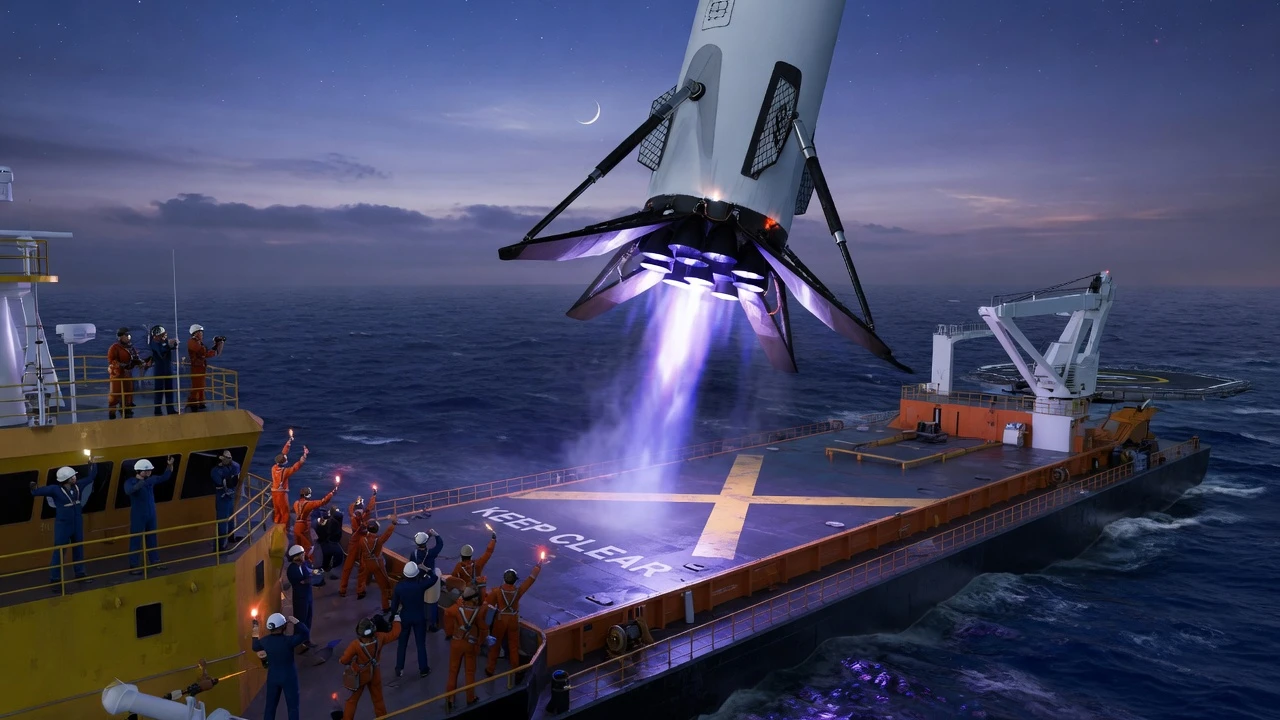
Booster landing — the dramatic culmination of retropropulsive recovery that makes reusability possible. - 5
Understand Starship Economics
Starship is designed for full, rapid reusability. Both Super Heavy booster and Starship upper stage return to launch site. Target: no refurbishment between flights (airline-like operations). If achieved, cost per kg drops to $50-100. The key challenge: heat shield durability for Starship reentry at orbital velocity (~28,000 km/h).
Tip: Starship's economics depend on achieving rapid reusability — same day turnaround. If refurbishment takes weeks, costs remain high despite reusability. - 6
Calculate Market Impact
At $200/kg, use cases that were uneconomical become viable: satellite internet constellations (Starlink), space tourism ($50K-500K per seat vs $50M), lunar cargo delivery, space manufacturing, and orbital solar power. At $50/kg, even asteroid mining becomes potentially profitable. The market is projected to grow from $15B (2026) to $100B+ (2035).
- 7
Evaluate Environmental Impact
Reusable rockets reduce manufacturing waste (fewer boosters built) but increase emissions from more frequent launches. A Falcon 9 launch emits ~300 tons of CO2. At 100 launches/year, that's 30,000 tons — equivalent to 6,500 cars. Starship's methane fuel is cleaner than kerosene but still produces CO2. Future green propellants (hydrogen, bio-methane) could reduce this.
Warning: Rocket emissions in the upper atmosphere have disproportionate climate impact — soot and alumina particles in the stratosphere have 100x the warming effect of ground-level emissions. - 8
Assess Launch Infrastructure
High launch cadence requires: automated launch processing, weather-resilient operations, multiple launch pads, rapid integration facilities, and range safety automation. SpaceX's Starbase facility aims for daily launches. The FAA is updating licensing processes to handle higher cadence. Ground infrastructure, not rockets, may become the bottleneck.
textLaunch Infrastructure Requirements: - Automated propellant loading - Autonomous flight safety system (AFSS) - Rapid integration cranes/fixtures - Weather monitoring + go/no-go criteria - Multiple pads for parallel operations - Downrange recovery vessels - Regulatory approval for high cadence - 9
Understand the Competitive Landscape
SpaceX dominates with 80%+ market share and 130+ launches in 2025. Blue Origin's New Glenn targets heavy-lift reuse. Rocket Lab's Neutron addresses the medium-lift market. China's Landspace and iSpace are developing reusable rockets. The competitive landscape will shift as more providers achieve reusability — but SpaceX's head start is enormous.
- 10
Project Future Trajectories
Near-term (2026-2028): Starship operational, point-to-point Earth transport tested. Mid-term (2028-2032): daily Starship flights, lunar cargo missions, first commercial space stations. Long-term (2032-2040): Mars cargo missions, orbital manufacturing, space-based solar power pilots. The enabling technology is rapid full reusability at scale.
Summary
Reusable rockets have reduced launch costs by 90% and are enabling a new space economy. SpaceX's Falcon 9 proved first-stage reuse with 20+ flights per booster. Starship aims for full, rapid reusability at $50-200/kg — 100x cheaper than the Space Shuttle. The key challenges are heat shield durability, refurbishment costs, and launch infrastructure for high cadence. At these price points, satellite constellations, space tourism, lunar economy, and eventually Mars colonization become economically viable.
Frequently Asked Questions
As of 2026, the record is 26 flights on a single booster. SpaceX has recovered 300+ boosters and reflown 250+. Average reuse count is increasing as refurbishment processes improve.
Starship completed its first orbital flight in 2025. Commercial payload delivery is expected in 2026-2027. Full, rapid reusability (same-day turnaround) is a multi-year goal, likely 2028-2030.
Yes — Falcon 9 Crew Dragon has flown 12+ crewed missions with reused boosters. Starship is designed to carry 100+ passengers. NASA's Artemis program uses Starship as the lunar lander.
Retropropulsive landing is extremely difficult to master. SpaceX spent years and crashed many boosters before succeeding. The engineering expertise, test infrastructure, and iterative development culture are hard to replicate.
Test Your Knowledge
1. What is the key innovation that enables rocket booster recovery?
Retropropulsive landing (using engines to decelerate during descent) is SpaceX's key innovation. It enables precise landing on a droneship or landing pad, which parachutes cannot achieve.
2. How much has reusability reduced launch costs?
From Space Shuttle ($54,500/kg) to Falcon 9 reused ($1,500/kg) is a 97% reduction. Starship targets $50-200/kg, which would be a 99%+ reduction from the Space Shuttle era.
3. What is the primary challenge for Starship reusability?
Starship reenters at ~28,000 km/h, requiring a heat shield that survives without significant refurbishment. SpaceX's hexagonal tile design is being iterated to achieve this.