How to Understand Grid Storage: Lithium-ion, Flow Batteries, and Pumped Hydro
Grid energy storage is the enabler of renewable energy — storing solar and wind power for when the sun doesn't shine and wind doesn't blow. This guide covers lithium-ion, flow batteries, pumped hydro, and emerging technologies.
Introduction
Grid energy storage is the enabler of renewable energy — storing solar and wind power for when the sun doesn't shine and wind doesn't blow. This guide covers lithium-ion, flow batteries, pumped hydro, and emerging technologies.
Prerequisites
- ✓ Basic electricity concepts (power, energy, voltage)
- ✓ Understanding of the electric grid
- ✓ Familiarity with renewable energy
Key Concepts
Step-by-Step Guide
- 1
Understand Why Grid Storage Matters
Renewable energy (solar, wind) is intermittent — it produces when the sun shines or wind blows, not when demand peaks. Grid storage bridges this gap: store excess renewable energy and discharge during peak demand. Without storage, renewable penetration above ~40% causes curtailment (wasted energy) and grid instability. With storage, 80-100% renewable grids are feasible. Global storage deployment: 108GW in 2025, projected 760GW by 2035.
textGrid Storage by Duration: Short (seconds-minutes): Frequency regulation Tech: Flywheels, supercapacitors, Li-ion Revenue: Ancillary services Medium (2-8 hours): Peak shaving, renewable shifting Tech: Li-ion batteries (dominant) Revenue: Energy arbitrage, capacity markets Long (8-100+ hours): Multi-day storage Tech: Pumped hydro, flow batteries, CAES, hydrogen Revenue: Resource adequacy, seasonal shifting - 2
Master Lithium-Ion Battery Storage
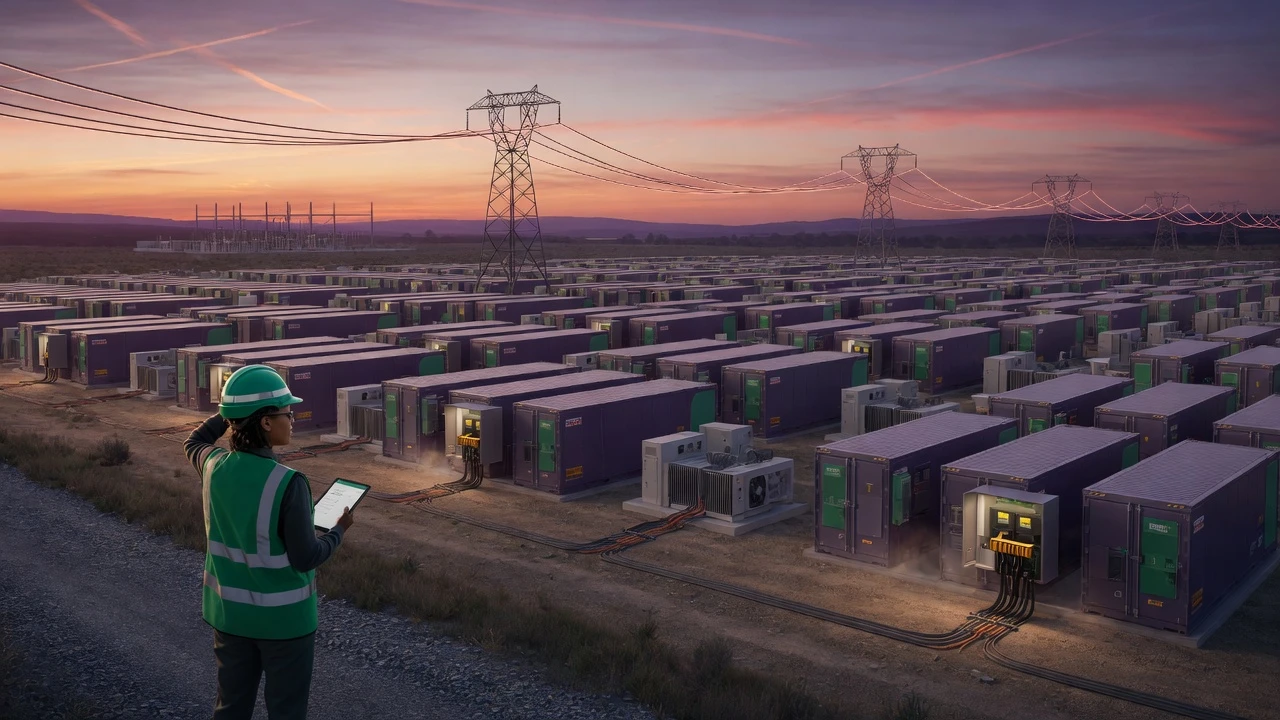
Li-ion dominates grid storage (90%+ of new deployments). Advantages: high round-trip efficiency (85-95%), fast response (ms), declining cost ($150-200/kWh in 2026), and modular/scalable. Disadvantages: 4-hour duration limit (cost increases for longer), fire risk (thermal runaway), and limited cycle life (5,000-10,000 cycles). Chemistries: LFP (safer, longer life, lower energy density) dominates grid storage; NMC (higher density) for space-constrained applications. Typical grid battery: 100MW/400MWh (4-hour), $150-200M.
Tip: LFP (lithium iron phosphate) is the dominant chemistry for grid storage — safer than NMC, longer cycle life (8,000-10,000 cycles), and lower cost. The trade-off (lower energy density) doesn't matter for stationary applications. - 3
Understand Flow Batteries
Flow batteries store energy in liquid electrolytes (vanadium, iron, organic) in external tanks. Power is determined by the cell stack size; energy by the tank size. This decoupling enables long durations (8-24+ hours) at lower cost than Li-ion. Advantages: unlimited cycle life (20,000+ cycles), no degradation, inherently safe (aqueous electrolyte), and independently scalable power/energy. Disadvantages: lower round-trip efficiency (65-75%), lower energy density (bulky), and higher upfront cost for short durations.
Flow battery electrolyte tanks — the energy storage medium. Tank size determines duration; cell stack determines power output. - 4
Evaluate Pumped Hydro Storage
Pumped hydro is the largest form of grid storage globally (95% of total stored energy). It pumps water to an upper reservoir during excess generation and releases it through turbines during peak demand. Advantages: very long duration (days to weeks), high capacity (GW-scale), 50+ year life, and mature technology. Disadvantages: geographic requirements (need elevation difference and water), environmental impact (flooding), long construction time (8-10 years), and limited sites. Round-trip efficiency: 70-80%.
Warning: Pumped hydro is the cheapest long-duration storage ($150-250/kWh for 10+ hour duration) but requires specific geography. Most good sites in developed countries are already developed. New projects face environmental permitting challenges. - 5
Explore Compressed Air Energy Storage (CAES)
CAES stores energy by compressing air into underground caverns (salt domes, aquifers) and releases it through turbines. Advantages: long duration (24+ hours), large capacity (100-300MW), and geological storage (no surface footprint). Disadvantages: requires specific geology (salt domes), lower efficiency (40-55% for traditional, 60-70% for advanced), and limited sites. Only 2 commercial CAES plants operate globally (Huntorf, Germany; McIntosh, Alabama). Advanced CAES (adiabatic — no natural gas combustion) targets 70%+ efficiency.
- 6
Assess Emerging Storage Technologies
Beyond established technologies: 1) Gravity storage (Energy Vault — stacking blocks, 35% efficiency), 2) Liquid air (Highview Power — cryogenic, 50-60% efficiency), 3) Thermal storage (molten salt, rocks — 40-70% efficiency), 4) Hydrogen (electrolysis + fuel cell — 30-40% round-trip), 5) Sodium-ion (similar to Li-ion but cheaper, lower density), 6) Iron-air (Form Energy — 100-hour duration, $20/kWh target, very low efficiency ~50%). Each targets a specific duration/cost niche.
textStorage Technology Comparison: Technology | Cost/kWh | Duration | RTE | Cycles ---------------|----------|----------|-------|------- Li-ion (LFP) | $150-200 | 2-8 hr | 90% | 8K Flow (Vanadium)| $200-350 | 8-24 hr | 70% | 20K+ Pumped Hydro | $150-250 | 12-168hr | 75% | 50+ CAES | $100-200 | 24+ hr | 55% | 30+ Iron-air | $20-50 | 100 hr | 45% | 10K Hydrogen | $200-500 | 100+ hr | 35% | 20+ Sodium-ion | $100-150 | 2-6 hr | 85% | 5K - 7
Understand Storage Economics
Storage revenue streams: 1) Energy arbitrage (buy low, sell high — $20-50/kW-year), 2) Capacity markets (guaranteed availability — $50-100/kW-year), 3) Frequency regulation (fast response — $10-30/kW-year), 4) Renewable integration (curtailment avoidance — varies), 5) Transmission deferral (avoid grid upgrades — varies). Stacking multiple revenue streams is essential for profitability. A 4-hour Li-ion battery typically earns $150-300/kW-year from stacked services.
Tip: Revenue stacking is the key to storage economics. No single revenue stream justifies the investment. A battery that does arbitrage + frequency regulation + capacity + transmission deferral can earn 3-5x more than one doing only arbitrage. - 8
Navigate Grid Storage Markets
Grid storage operates in several markets: 1) ISO/RTO markets (PJM, CAISO, ERCOT, NYISO) — storage participates directly in energy, ancillary services, and capacity markets. 2) Utility procurement — utilities contract storage for capacity, deferral, and renewable integration. 3) Merchant projects — developers build storage and sell into wholesale markets. 4) Behind-the-meter — commercial/industrial customers install storage for peak shaving and backup. FERC Order 841 (2020) requires RTOs to allow storage to participate in all markets.
Warning: Market rules vary by region. CAISO has the most storage-friendly rules (storage can participate in all markets). ERCOT has no capacity market (merchant risk). PJM has a strong frequency regulation market. Understand local market rules before investing. - 9
Plan Storage Deployment
Storage deployment strategy: 1) Identify the need (peaking capacity, renewable integration, grid stability), 2) Select technology based on duration (Li-ion for 2-8h, flow for 8-24h, pumped hydro/CAES for 24h+), 3) Size the system (MW and MWh based on load/generation profile), 4) Identify revenue streams (stack as many as possible), 5) Navigate interconnection and permitting, 6) Procure and construct. Typical timeline: 12-24 months for Li-ion, 3-5 years for pumped hydro.

Grid-scale battery installations require sophisticated control systems to manage charging, discharging, and grid services simultaneously. - 10
Project the Storage Future
Grid storage outlook: 2026 — Li-ion dominates (90%+ of new deployments), 4-hour standard. 2028-2032 — flow batteries gain share for 8+ hour applications, sodium-ion competes for short-duration. 2032-2038 — long-duration storage (iron-air, hydrogen, advanced CAES) enables 80-100% renewable grids. 2038+ — solid-state batteries may disrupt Li-ion for grid storage. Total market: $50B (2026) → $200B+ (2035). Key driver: renewable penetration — every 10% increase in renewables requires ~2-4 hours of storage.
Summary
Grid energy storage enables renewable energy penetration beyond 40% by storing excess solar/wind for peak demand. Li-ion (LFP) dominates 2-8 hour storage (90%+ of deployments, $150-200/kWh, 90% efficiency). Flow batteries serve 8-24 hour durations (20K+ cycles, 70% efficiency). Pumped hydro provides long-duration, GW-scale storage (75% efficiency, limited sites). Emerging technologies (iron-air, hydrogen, sodium-ion) target long-duration and low-cost niches. Revenue stacking (arbitrage + capacity + frequency regulation + transmission deferral) is essential for profitability. Market: 108GW (2025) → 760GW (2035), driven by renewable growth.
Frequently Asked Questions
Li-ion LFP batteries: 8,000-10,000 cycles (~10-15 years in grid service). Flow batteries: 20,000+ cycles (20-30+ years — no degradation). Pumped hydro: 50-100 years. Battery degradation is the main operating cost — plan for augmentation (adding capacity) every 5-7 years for Li-ion.
Power (MW) is how much electricity the system can deliver at once. Energy (MWh) is how long it can deliver that power. A 100MW/400MWh battery can deliver 100MW for 4 hours, or 50MW for 8 hours. Duration = Energy / Power.
LFP batteries (dominant in grid storage) are much safer than NMC — they don't experience thermal runaway as easily. However, large battery installations still require fire suppression systems, thermal monitoring, and physical separation between containers. No grid battery fire has caused off-site injuries, but property damage incidents have occurred.
Studies estimate 6-12 hours of storage for a 100% renewable grid (depending on solar/wind mix and geographic diversity). This includes short-duration (Li-ion, 4-8h) and long-duration (flow, pumped hydro, hydrogen, 12-100h+). Total storage needed for the US: ~500-800 GWh.
Test Your Knowledge
1. What is round-trip efficiency (RTE) and why does it matter?
RTE measures how much energy you get back compared to what you put in. Li-ion: 85-95% (only 5-15% lost). Pumped hydro: 70-80%. Hydrogen: 30-40%. Higher RTE means more valuable storage — less energy is wasted in the storage cycle.
2. Why do flow batteries enable longer duration than Li-ion?
Flow batteries decouple power (cell stack) from energy (electrolyte tanks). To increase duration, you simply add larger tanks — the cost per kWh decreases with duration. Li-ion requires adding more cells (both power and energy increase together), making long durations expensive.
3. What is the dominant battery chemistry for grid storage?
LFP dominates grid storage because it is safer (no thermal runaway), has longer cycle life (8,000-10,000 cycles vs 3,000-5,000 for NMC), and costs less. The lower energy density (vs NMC) doesn't matter for stationary applications where weight and size are less critical.