How to Secure HALEU Fuel Supply: The Bottleneck for Advanced Reactors
HALEU (High-Assay Low-Enriched Uranium) fuel — enriched to 5-20% U-235 — is essential for advanced reactors, but the supply chain doesn't exist at scale. This guide covers production, bottlenecks, and the race to build capacity.
Introduction
HALEU (High-Assay Low-Enriched Uranium) fuel — enriched to 5-20% U-235 — is essential for advanced reactors, but the supply chain doesn't exist at scale. This guide covers production, bottlenecks, and the race to build capacity.
Prerequisites
- ✓ Understanding of uranium enrichment
- ✓ Familiarity with nuclear fuel cycle
- ✓ Knowledge of advanced reactor designs
Key Concepts
Step-by-Step Guide
- 1
Understand Why HALEU is Needed
Advanced reactors (SMRs, Gen-IV) require HALEU fuel (5-20% U-235) for: higher burnup (longer fuel cycles), smaller core size (SMRs), and better neutron economy (fast reactors). Standard LWR fuel (3-5%) cannot achieve these performance characteristics. Most advanced reactor designs — TerraPower Natrium, X-energy Xe-100, Oklo Aurora, NuScale — require HALEU. Without HALEU, the advanced reactor industry cannot deploy.
Warning: No commercial HALEU production exists in the US. The first advanced reactors are scheduled for 2028-2030, but fuel may not be ready. This is a critical path bottleneck. - 2
Map the HALEU Supply Chain
HALEU supply chain: 1) Uranium feed (natural, depleted, or downblended HEU), 2) Enrichment to 5-20% (gas centrifuge), 3) Conversion to UO2 or metallic form (fuel fabrication), 4) Fuel fabrication (TRISO, metallic, or oxide fuel), 5) Transportation to reactor. Each step has limited capacity for HALEU-specific operations.
textHALEU Supply Chain: Feed: Natural U (0.7%) or Downblended HEU ↓ Enrichment: 5-20% U-235 (gas centrifuge) ↓ Conversion: UF6 → UO2 or U-metal ↓ Fabrication: TRISO, metallic, or oxide fuel ↓ Transport: Type 30B cylinders (HALEU-specific) Current US capacity: ~0 tonnes/year Needed by 2030: 40+ tonnes/year - 3
Understand Enrichment Requirements
HALEU enrichment requires significantly more SWU than LWR fuel: 3.5% LEU = ~4.5 SWU/kg, 5% HALEU = ~7.5 SWU/kg, 10% HALEU = ~15 SWU/kg, 19.75% HALEU = ~30 SWU/kg. The US has limited enrichment capacity (Centrus LEU plant in Piketon, Ohio — first HALEU production in 2023, ~0.9 tonnes/year initial). Global HALEU capacity: Russia (Rosatom) dominates with 20+ tonnes/year. Urenco (Netherlands/UK/Germany) has some HALEU capability.
Tip: Russia is the only country with significant HALEU production capacity. US advanced reactors cannot rely on Russian fuel — especially after the 2024 ban on Russian uranium imports. Domestic capacity is critical. - 4
Evaluate Downblending as a Source
Downblending HEU (weapons-grade, 90%+) with natural or depleted uranium produces HALEU quickly without new enrichment. Sources: US government HEU stockpiles (limited), retired weapons material (classified quantities), and NNSA surplus. The US has downblended ~500 tonnes of HEU since 1993 (Megatons to Megawatts program). However, remaining HEU stockpiles are limited and downblending produces LEU (4-5%), not HALEU (5-20%) — additional enrichment is still needed.
Warning: Downblending is a bridge, not a solution. Remaining HEU stockpiles are limited, and the process produces LEU that still needs further enrichment to reach HALEU levels. New enrichment capacity is unavoidable. - 5
Assess Criticality Safety Challenges
HALEU enrichment and handling require different criticality safety limits than LEU. At >5% enrichment, the mass limit for criticality safety drops significantly. Existing enrichment facilities were designed for LEU (3-5%) and may not be licensed for HALEU (5-20%). Modifications: smaller cylinder sizes (Type 30B vs Type 48Y), reduced batch sizes, additional neutron absorbers, and revised safety analyses. These changes increase cost and reduce throughput.

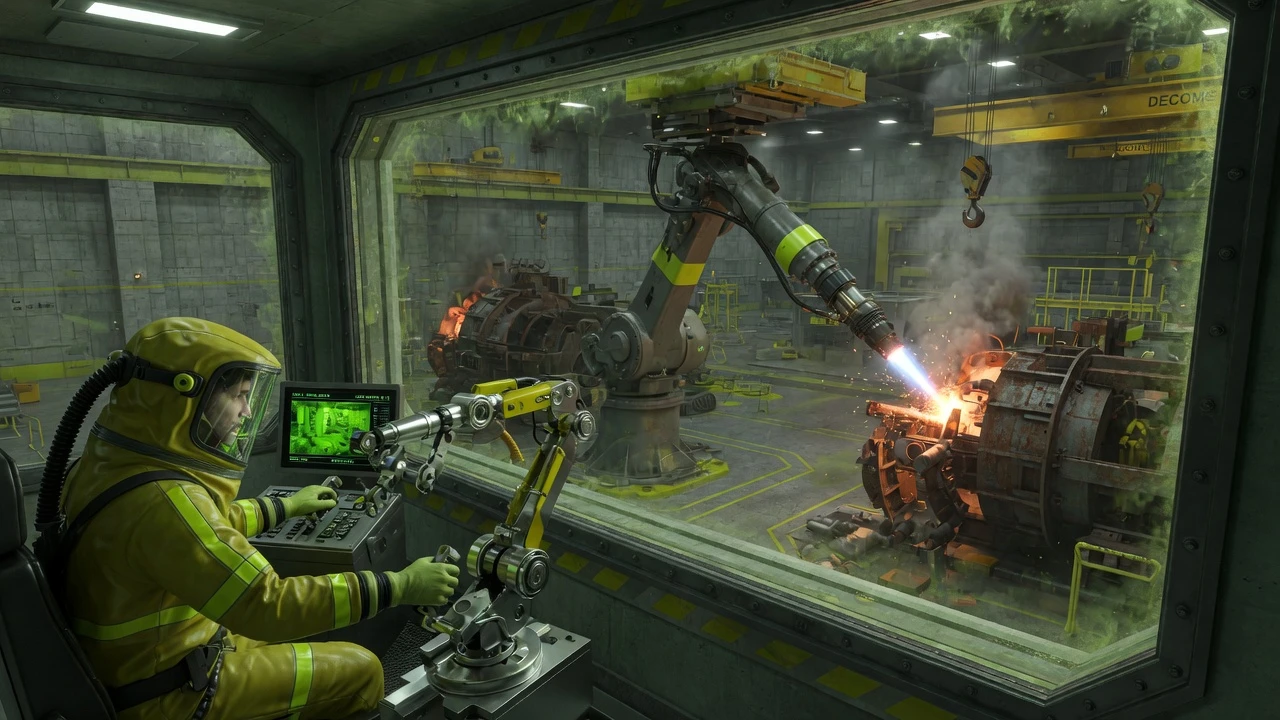
SMR and advanced reactor vessels require HALEU fuel — the fuel supply chain must be ready before reactor deployment. - 6
Track US HALEU Development
DOE HALEU Availability Program: $700M (Inflation Reduction Act) to support domestic HALEU production. Centrus Energy: first US HALEU production (2023, Piketon OH, 0.9 tonnes/year initial, expanding to 5+ tonnes). Urenco USA: planning HALEU capability at Eunice NM. X-energy: TRISO fuel fabrication facility (Oak Ridge TN) for Xe-100 fuel. DOE is also exploring government-owned HALEU stockpile as a strategic reserve.
textUS HALEU Development: Centrus (Piketon OH): 0.9 t/yr → 5+ t/yr (2027) Urenco (Eunice NM): Planning HALEU capability X-energy (Oak Ridge TN): TRISO fuel facility DOE stockpile: Strategic HALEU reserve Timeline: 2023: First US HALEU produced (Centrus) 2025-2027: Scale-up to 5+ t/yr 2028-2030: Need 40+ t/yr for first reactors Gap: 30-35 tonnes shortfall by 2030 - 7
Understand Fuel Fabrication for HALEU
HALEU fuel forms vary by reactor design: TRISO particles (X-energy Xe-100 — uranium oxycarbide kernels in carbon/SiC layers), metallic fuel (TerraPower Natrium — uranium-zirconium alloy), oxide fuel (NuScale — UO2 pellets similar to LWR but higher enrichment). Each requires dedicated fabrication facilities. TRISO fabrication is especially complex — coating ~100,000 particles per fuel element. No commercial TRISO fabrication facility exists in the US yet (X-energy is building one).
- 8
Evaluate the Russian Dependency
Russia (Rosatom/TVEL) is the only established commercial HALEU supplier — 20+ tonnes/year capacity. In 2024, the US banned Russian uranium imports (effective 2028, with waivers through 2027). This creates urgency for domestic capacity but also a supply gap. Advanced reactor developers must secure non-Russian fuel or face delays. Some developers (TerraPower) have acknowledged fuel supply challenges for their 2028 startup target.
Warning: The 2024 Russian uranium import ban creates a 2028 cliff. Without domestic HALEU capacity by 2028, advanced reactor projects will be delayed. The ban is necessary for energy security but creates near-term supply risk. - 9
Assess Cost and Economics
HALEU cost: ~$5,000-15,000/kg (vs ~$1,000-2,000/kg for LEU). The higher cost reflects: more SWU (4-8x), smaller batch sizes (criticality limits), dedicated facilities, and limited supply. For advanced reactors, fuel cost is a smaller fraction of total cost (capital dominates), so HALEU cost is manageable. But first-of-a-kind fuel costs will be high — government subsidies (DOE HALEU program) are essential to bridge the gap.
Tip: Fuel cost is typically 10-15% of nuclear electricity cost. Even at 5x LEU cost, HALEU adds only $5-10/MWh to the electricity price — manageable compared to the $50-100/MWh capital cost of advanced reactors. - 10
Plan the Path Forward
Critical actions for HALEU supply: 1) Scale Centrus to 5+ tonnes/year by 2027, 2) License Urenco for HALEU enrichment, 3) Build TRISO and metallic fuel fabrication facilities, 4) Establish a US government HALEU strategic reserve, 5) Develop downblending programs for near-term supply, 6) Engage NRC on HALEU-specific licensing (transport, storage, handling). The HALEU supply chain is the critical path for the entire US advanced reactor industry — without it, no reactors can operate.
Summary
HALEU fuel (5-20% U-235) is essential for advanced reactors but the US supply chain doesn't exist at scale. Russia dominates global HALEU production (20+ tonnes/year), but the 2024 US ban on Russian uranium creates urgency for domestic capacity. Centrus Energy produced the first US HALEU in 2023 (0.9 tonnes/year, scaling to 5+). The US needs 40+ tonnes/year by 2030 for planned reactors — a significant gap. Key challenges: enrichment capacity (4-8x more SWU than LEU), criticality safety, fuel fabrication (TRISO, metallic), and cost ($5,000-15,000/kg). The HALEU supply chain is the critical path for the entire advanced reactor industry.
Frequently Asked Questions
Advanced reactors need higher enrichment (5-20% vs 3-5%) for longer fuel cycles, smaller cores, and better neutron economy. Standard LEU cannot achieve the burnup and power density required by SMRs and Gen-IV designs. HALEU enables 2-4x longer fuel cycles and smaller reactor footprints.
It varies by design: TerraPower Natrium (~345MWe) needs ~5-8 tonnes initial core load. X-energy Xe-100 (80MWe) needs ~1-2 tonnes. Oklo Aurora (15MWe) needs <1 tonne. Total US demand by 2035: 40-100 tonnes/year depending on deployment rate.
It is tight. Centrus is scaling from 0.9 to 5+ tonnes/year by 2027. The 2024 ban on Russian uranium (effective 2028) creates urgency. Without aggressive capacity expansion and DOE support, there will be a 30-35 tonne shortfall by 2030, potentially delaying advanced reactor deployment.
HALEU is 5-20% U-235 (cannot be used for weapons without further enrichment). HEU is 20%+ (weapons-usable at 90%+). HALEU is classified as low-enriched (below the 20% threshold) but requires stricter handling than standard LEU (3-5%) due to criticality safety concerns.
Test Your Knowledge
1. Why does HALEU require more enrichment effort (SWU) than standard LEU?
Enrichment effort (SWU) increases non-linearly with target assay. Going from 0.7% to 3.5% requires ~4.5 SWU/kg, but 0.7% to 19.75% requires ~30 SWU/kg — nearly 7x more effort. This is because each successive enrichment step has less U-235 to work with.
2. What is the main near-term risk to the US advanced reactor industry?
The US has no commercial HALEU production at scale. The 2024 ban on Russian uranium (effective 2028) eliminates the fallback supplier. Without domestic HALEU capacity by 2028-2030, advanced reactors cannot fuel their cores — regardless of regulatory or economic progress.
3. What is downblending and why is it a limited solution?
Downblending mixes weapons-grade HEU (90%+) with natural or depleted uranium to produce lower-enriched material. It is the fastest source of HALEU but is limited by available HEU stockpiles. Also, downblending typically produces LEU (4-5%), not HALEU (5-20%) — further enrichment is still needed.