How to Evaluate Solid-State Batteries: Chemistry, Manufacturing, and Timeline
Solid-state batteries promise 2-3x energy density, instant charging, and no fire risk — replacing the flammable liquid electrolyte of lithium-ion with a solid. This guide covers the chemistry, manufacturing, and commercialization timeline.
Introduction
Solid-state batteries promise 2-3x energy density, instant charging, and no fire risk — replacing the flammable liquid electrolyte of lithium-ion with a solid. This guide covers the chemistry, manufacturing, and commercialization timeline.
Prerequisites
- ✓ Basic electrochemistry (anode, cathode, electrolyte)
- ✓ Understanding of lithium-ion batteries
- ✓ Materials science familiarity
Key Concepts
Step-by-Step Guide
- 1
Understand the Solid-State Advantage
Conventional Li-ion batteries use a flammable liquid electrolyte. Solid-state batteries replace it with a solid electrolyte, enabling: 1) Lithium metal anode (10x capacity of graphite), 2) No flammable liquid (inherent safety), 3) Wider operating temperature (-30°C to 100°C), 4) Faster charging (solid electrolyte enables higher current). Result: 400-500 Wh/kg energy density (vs 250-300 for Li-ion) and no fire risk.
textBattery Energy Density Comparison: Type | Wh/kg | Wh/L | Safety ------------------|--------|-------|-------- Li-ion (NMC) | 250-300| 650 | Flammable Li-ion (LFP) | 160-200| 400 | Safer Solid-state (SSB) | 400-500| 1000+ | Non-flammable Li-metal SSB | 500-600| 1200+ | Non-flammable Target: 500+ Wh/kg, 1000+ Wh/L Charging: <15 min to 80% - 2
Compare Solid Electrolyte Types
Four main solid electrolyte families: 1) Oxides (LLZO — lithium lanthanum zirconium oxide): high conductivity, stable, but brittle and hard to manufacture. 2) Sulfides (Li6PS5Cl — argyrodite): highest conductivity, soft (good contact), but air-sensitive (releases H2S). 3) Polymers (PEO-based): flexible, easy processing, but low conductivity at room temperature (needs 60-80°C operation). 4) Halides (Li3YCl6): good stability with cathodes, moderate conductivity. Each has trade-offs.
Tip: Sulfide electrolytes (QuantumScape, Solid Power) have the best conductivity but require dry rooms (moisture control). Oxide electrolytes (Toyota, QuantumScape) are more stable but harder to manufacture at scale. - 3
Understand the Lithium Metal Anode
The key advantage of solid-state is enabling lithium metal anodes. Li metal has a theoretical capacity of 3,860 mAh/g (vs 372 for graphite — 10x more). This is why SSB energy density is so much higher. However, Li metal forms dendrites during charging — metallic whiskers that pierce the electrolyte and short the battery. Solid electrolytes aim to mechanically block dendrite growth, but no electrolyte has completely solved this yet.
Warning: Dendrite growth is the #1 technical challenge for solid-state batteries. At high charge rates, dendrites penetrate even hard ceramic electrolytes. Most SSB prototypes work at low charge rates only — fast charging is a major unsolved challenge. - 4
Master the Manufacturing Challenge
SSB manufacturing is fundamentally different from Li-ion. Key challenges: 1) Solid-solid interface (no liquid to wet surfaces — poor contact between layers), 2) Pressure requirement (SSBs need 1-10 MPa external pressure to maintain contact — impractical for EVs), 3) Thin electrolyte (need <20μm for energy density, but hard to make defect-free), 4) Scale (no existing high-volume SSB manufacturing line). Current cost: $500-1,000/kWh (vs $100-150 for Li-ion).
Solid-state battery manufacturing requires dry rooms, high-precision deposition, and novel assembly processes — a complete departure from Li-ion production. - 5
Track the Commercialization Race
Major players and timelines: Toyota — sulfide electrolyte, targeting 2027-2028 for EV prototype. QuantumScape — oxide (LLZO), 24-layer cells in testing, targeting 2026-2027 for automotive. Solid Power — sulfide, pilot line operational, partnering with BMW and Ford. Samsung SDI — oxide, targeting 2027. CATL — sulfide, targeting 2030. Factorial — polymer-composite, Mercedes partnership. SES AI — hybrid (liquid + solid). Most are 3-5 years from commercial production.
textSSB Commercialization Tracker (2026): QuantumScape: 24-layer cells, 2026-2027 auto Solid Power: Pilot line, BMW/Ford partners Toyota: 2027-2028 prototype EV Samsung SDI: 2027 pilot, 2030 production CATL: 2030 target Factorial: Mercedes partnership SES AI: Hybrid approach First market: Consumer electronics (2026) EV market: 2028-2032 Mass market: 2035+ - 6
Understand the EV Application
For EVs, SSBs would enable: 500+ mile range (vs 300-400 today), 10-minute charging (vs 30-40 min), no thermal runaway (no fire risk), and 20-30% lighter battery pack. Toyota targets 1,000 km range with SSB. However, EV SSBs need: 1,000+ cycle life, $100/kWh cost, operation at ambient pressure (no external pressure), and automotive-grade reliability. These are significant engineering challenges beyond lab-scale demonstrations.
Warning: Lab-scale SSB cells show promising performance, but scaling to automotive-grade — 1,000+ cycles, 10+ year life, ambient pressure, $100/kWh — is a 5-10 year challenge. Do not expect SSB EVs before 2028-2032. - 7
Evaluate SSB for Consumer Electronics
Consumer electronics (phones, laptops, wearables) will be the first SSB market — smaller cells, lower volume, higher price tolerance. Samsung demonstrated a 50% capacity increase for phone batteries using SSB. Apple is exploring SSB for future devices. Timeline: 2026-2028 for premium devices. Advantages: thinner batteries, no swelling, no fire risk. Disadvantages: higher cost (consumers pay premium for thin/safe).
- 8
Assess the Cost Trajectory
SSB cost: $500-1,000/kWh today (lab/pilot). Target: $100-150/kWh by 2030-2035 (competitive with Li-ion). Cost reduction drivers: scale manufacturing, reduce electrolyte thickness, eliminate dry room (for oxide), and simplify cell design (no separator, no liquid filling). The key cost barrier: solid electrolyte material cost ($50-200/kg for sulfides, $100-500/kg for oxides) vs $10-20/kg for liquid electrolyte.
Tip: SSBs may always cost 20-50% more than Li-ion due to more complex manufacturing. The value proposition is performance (energy density, safety, charging) not cost. SSBs will compete in premium segments first. - 9
Understand Hybrid Approaches
Several companies are pursuing hybrid approaches: semi-solid (some liquid, some solid — reduces risk, easier manufacturing), and composite electrolytes (polymer + ceramic — combines flexibility and conductivity). These bridge technologies may commercialize faster than full SSBs. SES AI (hybrid Li-metal), StoreDot (semi-solid silicon-dominant), and 24M (semi-solid manufacturing) are examples. Hybrid may reach market 2-3 years before full SSB.
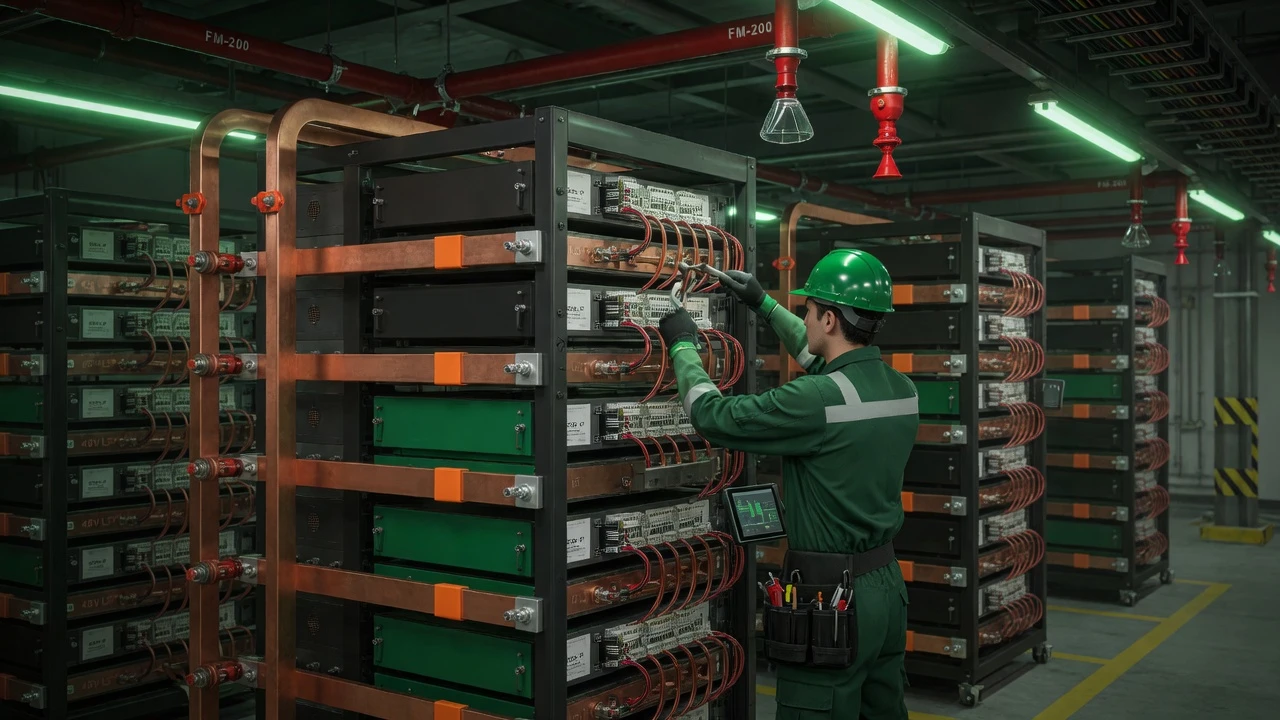
Battery manufacturing infrastructure for Li-ion cannot be directly repurposed for SSB — new processes, equipment, and facilities are needed. - 10
Project the Future
SSB timeline: 2026-2028 — consumer electronics, small cells, premium pricing. 2028-2032 — first EV applications (luxury/performance), $200-300/kWh. 2032-2038 — mainstream EVs, $100-150/kWh, if manufacturing challenges are solved. 2038+ — potential Li-ion replacement for most applications. Key uncertainty: whether dendrite suppression at high charge rates can be solved. If not, SSBs will be limited to slow-charging applications (consumer electronics, drones).
Summary
Solid-state batteries replace the flammable liquid electrolyte with a solid, enabling lithium metal anodes (10x capacity of graphite), 400-500 Wh/kg energy density, and inherent safety. The four electrolyte families (oxide, sulfide, polymer, halide) each have trade-offs. The #1 challenge is dendrite suppression at high charge rates. Manufacturing is fundamentally different from Li-ion (solid-solid interfaces, pressure requirements, thin electrolyte). Current cost: $500-1,000/kWh, targeting $100-150/kWh by 2030-2035. First market: consumer electronics (2026-2028). EV market: 2028-2032 for luxury, 2032-2038 for mainstream. Toyota, QuantumScape, Solid Power, and Samsung SDI are leading the race.
Frequently Asked Questions
First EV applications: 2028-2032 (luxury/performance vehicles). Mainstream EVs: 2032-2038, if manufacturing and cost challenges are solved. Toyota targets 2027-2028 for a prototype EV. QuantumScape targets 2026-2027 for automotive cells. Do not expect affordable SSB EVs before 2032.
Yes — inherently safer than Li-ion. The solid electrolyte is non-flammable, eliminating thermal runaway (the cause of Li-ion fires). However, lithium metal anodes are still reactive with moisture/air. The safety advantage is real but manufacturing quality control remains critical.
Three reasons: 1) Solid electrolyte materials cost $50-500/kg (vs $10-20/kg for liquid), 2) Manufacturing requires new processes (dry rooms, high-precision deposition, pressure application), 3) No economies of scale yet. Target: $100-150/kWh by 2030-2035, but SSBs may always cost 20-50% more than Li-ion.
In theory yes — solid electrolytes can handle high current densities. In practice, fast charging causes dendrite growth in most solid electrolytes. Most SSB prototypes work at slow charge rates only. Solving fast-charging dendrite suppression is the key remaining technical challenge.
Test Your Knowledge
1. What is the primary advantage of a lithium metal anode over graphite?
Lithium metal has a theoretical capacity of 3,860 mAh/g — 10x higher than graphite (372 mAh/g). This is the main reason solid-state batteries achieve 400-500 Wh/kg energy density. However, Li metal forms dendrites during charging, which solid electrolytes aim to suppress.
2. What is the #1 technical challenge for solid-state batteries?
Dendrites — metallic whiskers that grow from the lithium anode during charging — can penetrate even hard ceramic electrolytes at high charge rates. This causes short circuits and limits fast charging. No solid electrolyte has completely solved dendrite suppression at automotive charge rates.
3. Which solid electrolyte type has the highest ionic conductivity?
Sulfide electrolytes (e.g., Li6PS5Cl — argyrodite) have the highest ionic conductivity at room temperature, approaching liquid electrolyte levels. However, they are air-sensitive (release H2S gas when exposed to moisture) and require dry room manufacturing.