How to Evaluate SMR Designs: 8 Leading Small Modular Reactors Compared
Small Modular Reactors (SMRs) represent a new paradigm in nuclear energy — factory-built, scalable, and safer than traditional plants. This guide compares 8 leading SMR designs across coolant type, fuel, power output, and regulatory status.

Introduction
Small Modular Reactors (SMRs) represent a new paradigm in nuclear energy — factory-built, scalable, and safer than traditional plants. This guide compares 8 leading SMR designs across coolant type, fuel, power output, and regulatory status.
Prerequisites
- ✓ Basic understanding of nuclear fission
- ✓ Familiarity with reactor concepts (fuel, coolant, moderator)
- ✓ General physics knowledge
Key Concepts
Step-by-Step Guide
- 1
Understand the SMR Concept
SMRs are designed to solve the key problems of traditional nuclear: high capital cost, long construction times, and large project risk. By building modules in a factory and shipping them to site, SMRs aim to reduce construction to 3 years and capital cost to under $3,000/kW.
- 2
Compare Light Water SMRs
LWR-based SMRs use the same proven technology as current reactors but at smaller scale. NuScale VOYGR (77 MW/module, NRC-certified), GE Hitachi BWRX-300 (300 MW, under NRC review), and Rolls-Royce SMR (470 MW, UK design). These have the lowest technology risk but also the lowest efficiency improvements.
Tip: NuScale is the first and only NRC-certified SMR design. This regulatory precedent benefits all subsequent SMR applications. - 3
Evaluate Advanced Reactor SMRs
Non-LWR SMRs use different coolants for improved safety and efficiency: High-Temperature Gas Reactors (HTGR) — helium-cooled, graphite-moderated, 950°C outlet (X-energy Xe-100). Sodium-Cooled Fast Reactors (SFR) — liquid sodium, no moderator, breeder capable (TerraPower Natrium). Molten Salt Reactors (MSR) — fuel dissolved in molten salt, online refueling (Kairos Hermes).
- 4
Analyze Coolant Trade-offs
Each coolant has advantages: Water — proven, abundant, but limited to ~320°C. Helium — inert, high temperature, but high-pressure system. Sodium — excellent heat transfer, low pressure, but reacts violently with water/air. Molten salt — low pressure, high temperature, but corrosive.
Warning: Sodium-cooled reactors require an intermediate sodium loop to prevent sodium-water reactions. This adds cost and complexity. - 5
Understand Fuel Design Differences
SMR fuels vary significantly: LWR SMRs use standard UO2 pellets in zirconium cladding (5% enrichment). HTGRs use TRISO particles — uranium kernels coated in carbon/silicon carbide layers (15% enrichment). SFRs use metallic or nitride fuel (15-20% enrichment). MSRs dissolve fuel directly in the salt coolant.
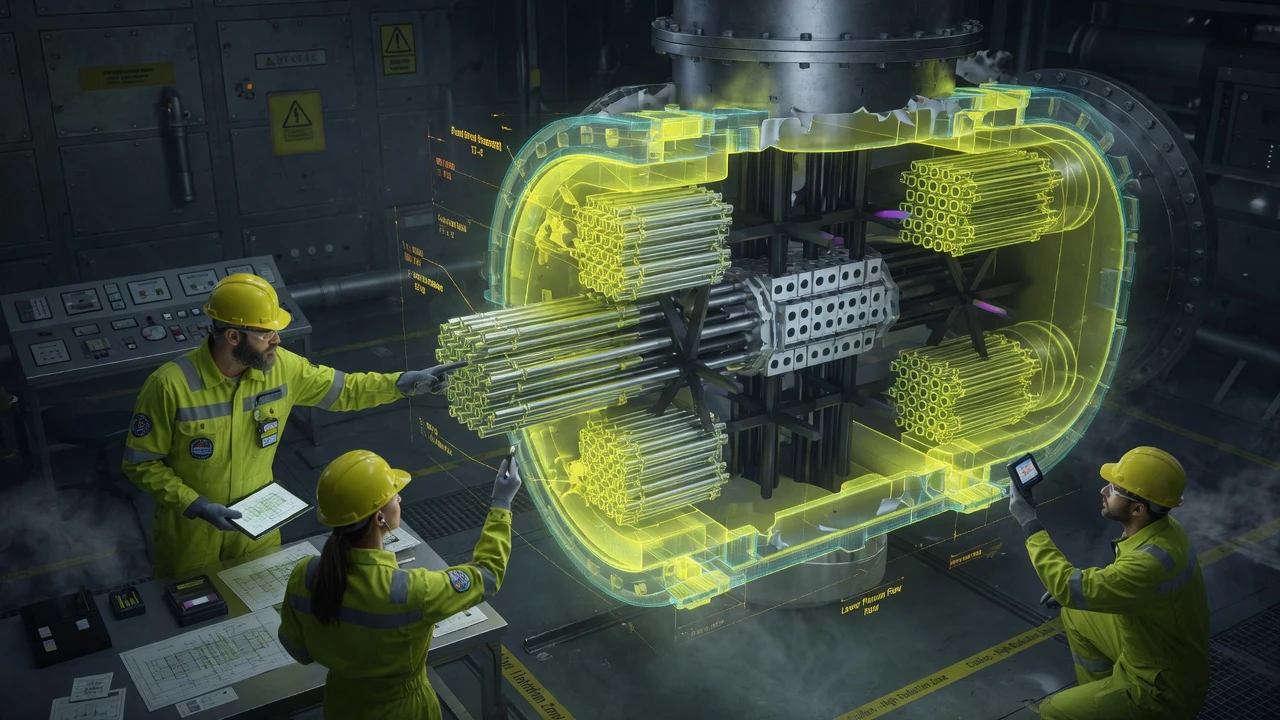
Reactor internals vary dramatically by design — from conventional LWR fuel assemblies to TRISO-coated particles. - 6
Evaluate Passive Safety Systems
SMRs rely on passive safety — no active pumps or power needed for emergency cooling. NuScale uses natural circulation and gravity-driven emergency cooling. TerraPower Natrium uses pool-type sodium with large thermal inertia. X-energy Xe-100 uses TRISO fuel that cannot melt in conceivable accidents and natural convection for decay heat removal.
Tip: TRISO fuel is the most robust fuel form — it retains fission products up to 1,600°C without failure, making meltdown physically impossible. - 7
Assess Economics and Deployment
SMR economics depend on factory learning curves. First-of-a-kind (FOAK) costs are high ($8,000-12,000/kW), but nth-of-a-kind (NOAK) costs target $3,000-4,000/kW. The key challenge: you need to build many units to reach NOAK costs, but the first units are expensive.
textSMR Cost Projections: FOAK (1st unit): $8,000-12,000/kW Module 5-10: $5,000-7,000/kW NOAK (20+): $3,000-4,000/kW Target LCOE: $40-60/MWh - 8
Review Regulatory Status
NRC certification status: NuScale VOYGR — certified (2026). GE Hitachi BWRX-300 — under review (decision expected 2027). TerraPower Natrium — construction permit application filed. X-energy Xe-100 — under pre-application review. Oklo Aurora — site permit received, COL under review.
Warning: NRC licensing for non-LWR designs takes longer because the review process was designed for light water reactors. The NRC is developing risk-informed pathways for advanced reactors. - 9
Understand the HALEU Supply Challenge
Most advanced SMRs require HALEU fuel (5-20% enrichment), which is not commercially available in the US. Current US enrichment capacity only produces LEU (up to 5%). The DOE is funding HALEU demonstration production, but a commercial supply chain is 3-5 years away.
Tip: The HALEU supply chain is the single biggest bottleneck for advanced reactor deployment. Without domestic HALEU, US SMR companies must rely on foreign suppliers. - 10
Plan Your SMR Evaluation
When evaluating SMRs for your use case, consider: Technology maturity (TRL level), regulatory status, fuel availability, cost projections, siting requirements, and operational workforce. For near-term deployment (before 2030), LWR-based SMRs are the only realistic option. For 2030+, advanced designs become viable.
- 11
Consider Hybrid Energy Systems
SMRs excel in hybrid configurations — providing baseload power while integrating with renewables and storage. TerraPower Natrium includes integrated molten salt energy storage (500 MWh), enabling load following. SMRs can also provide industrial heat for hydrogen production, desalination, or chemical processing.
Summary
Small Modular Reactors offer a path to nuclear energy that is factory-built, passively safe, and economically scalable. LWR-based SMRs (NuScale, GE Hitachi) are nearest to deployment with proven technology. Advanced SMRs (TerraPower, X-energy, Kairos) offer higher efficiency and better safety but face regulatory and fuel supply challenges. The HALEU fuel supply chain is the critical bottleneck for advanced reactor deployment.
Frequently Asked Questions
SMRs have larger safety margins due to passive safety systems, smaller radioactive inventory, and underground containment. They do not require active power for emergency cooling, eliminating the class of accidents (like Fukushima) caused by station blackout.
NuScale's UAMPS project in Idaho targets 2030 for first module operation. TerraPower's Natrium in Wyoming targets 2030-2031. GE Hitachi BWRX-300 in Canada targets 2029.
Yes — SMRs are ideally sized for replacing coal plants (100-500 MW). The DOE estimates 300+ coal plant sites in the US could be repurposed for SMRs, reusing existing transmission infrastructure.
SMRs produce more waste per unit of energy due to lower burnup in some designs. However, advanced reactors can potentially recycle waste from existing reactors, turning a liability into fuel.
Test Your Knowledge
1. Which SMR design has received full NRC certification?
NuScale's VOYGR-6 became the first SMR design to receive NRC certification in 2026, after 8 years and $500M in review costs.
2. What is the main advantage of TRISO fuel?
TRISO particles have multiple layers of carbon and silicon carbide that contain fission products up to 1,600°C, well beyond any conceivable accident temperature.
3. What is the biggest supply chain challenge for advanced SMRs?
Most advanced SMR designs require HALEU fuel (5-20% enrichment), which is not commercially produced in the US. Domestic HALEU production is 3-5 years away.