How to Compare Hydrogen Storage: Compressed, Liquid, and Solid-State Methods
Hydrogen is the lightest element in the universe — making it an incredibly energy-dense fuel but notoriously hard to store. This guide covers compressed, liquid, and solid-state hydrogen storage methods and their applications.

Introduction
Hydrogen is the lightest element in the universe — making it an incredibly energy-dense fuel but notoriously hard to store. This guide covers compressed, liquid, and solid-state hydrogen storage methods and their applications.
Prerequisites
- ✓ Basic chemistry (H2 molecule, bonds)
- ✓ Understanding of energy density concepts
- ✓ Familiarity with fuel cells and hydrogen economy
Key Concepts
Step-by-Step Guide
- 1
Understand the Hydrogen Storage Challenge
Hydrogen has the highest gravimetric energy density of any fuel (33.3 kWh/kg — 3x gasoline). But it has the lowest volumetric density (0.003 kWh/L at atmospheric pressure). The storage challenge is packing enough H2 molecules into a small volume. Solutions: compress to 700 bar (1.3 kWh/L), liquefy at -253°C (2.4 kWh/L), or store in solid materials (metal hydrides, chemical carriers). Each has trade-offs in weight, volume, cost, and energy penalty.
textHydrogen Storage Comparison: Method | kWh/L | kWh/kg | Pressure | Temp | Cost ----------------|-------|--------|----------|---------|------ Gas 350 bar | 0.8 | 6 | 350 bar | Ambient | Low Gas 700 bar | 1.3 | 5.5 | 700 bar | Ambient | Med Liquid (LH2) | 2.4 | 20 | 1 bar | -253°C | High Metal hydride | 5-7 | 2-3 | 1-10 bar | 50-300°C| V.High LOHC | 1.5 | 1.7 | 1 bar | Ambient | Med Ammonia (NH3) | 3.2 | 5.2 | 8 bar | -33°C | Low Gasoline (ref): 8.8 kWh/L, 12.2 kWh/kg - 2
Master Compressed Hydrogen (CGH2)
Compressed gas is the most mature storage method. Type IV tanks (carbon fiber + plastic liner) store H2 at 700 bar — used in Toyota Mirai, Hyundai Nexo, and heavy-duty trucks. Advantages: fast filling (5-10 min), ambient temperature, proven technology. Disadvantages: low volumetric density (1.3 kWh/L — 15% of gasoline), heavy tanks (Type IV: ~5% H2 by weight), and compression energy (10-15% of H2 energy content). Tank cost: $15-25/kWh (target: $8/kWh by 2030).
Tip: Type IV tanks (carbon fiber composite with plastic liner) are the standard for 700 bar vehicle storage. They are lighter than Type III (metal liner) but more expensive. Carbon fiber cost is the main driver — reducing carbon fiber usage is key to cost reduction. - 3
Understand Liquid Hydrogen (LH2)
Liquefying hydrogen at -253°C (20K) achieves 2x the volumetric density of 700 bar gas (2.4 kWh/L). Advantages: higher density, lower pressure (1 bar). Disadvantages: 30-40% energy penalty for liquefaction (vs 10-15% for compression), boil-off losses (0.1-0.3% per day in large tanks, more in small), and cryogenic equipment cost. Best for: large-scale transport (ships, trains), aviation (short-range), and bulk storage. Not suitable for passenger cars (boil-off in small tanks).
Warning: LH2 boil-off is a major challenge for small tanks. A vehicle LH2 tank loses 0.5-1% per day — meaning a full tank empties in 3-6 months if unused. LH2 is better suited for fleet vehicles with daily use or large-scale storage where boil-off rates are lower. - 4
Explore Metal Hydride Storage
Metal hydrides (MgH2, LaNi5, NaAlH4) absorb hydrogen into their crystal structure — like a sponge. Advantages: high volumetric density (5-7 kWh/L — higher than liquid H2), low pressure (1-10 bar), and safety (no high pressure, no boil-off). Disadvantages: very heavy (2-3 kWh/kg — 10x heavier than CGH2), slow kinetics (minutes to hours for absorption/desorption), and thermal management (heat release during charging, heat required for discharge). Best for: stationary storage, submarines, and niche applications where weight doesn't matter.
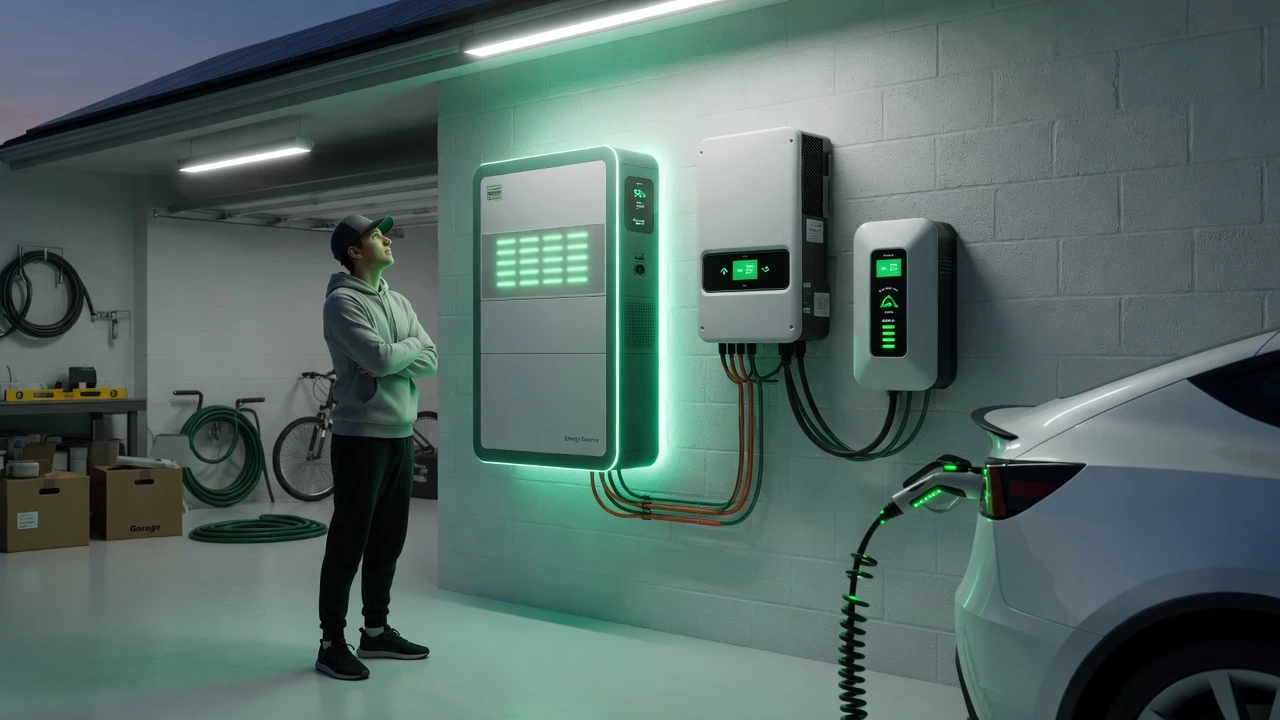
Hydrogen storage for residential and commercial use must balance density, safety, and cost — metal hydrides offer safety but are too heavy for vehicles. - 5
Evaluate Chemical Carriers (LOHC and Ammonia)
Liquid Organic Hydrogen Carriers (LOHCs): store H2 in liquid organic compounds (e.g., toluene/methylcyclohexane) at ambient conditions. Release H2 by heating (300-350°C). Advantages: ambient storage, existing infrastructure (oil tanks, ships). Disadvantages: low capacity (1.5-2 kWh/L), energy penalty for dehydrogenation (30-35%), and catalyst cost. Ammonia (NH3): stores H2 as liquid at 8 bar/-33°C. 17.6% H2 by weight. Advantages: existing infrastructure, high density (3.2 kWh/L), proven transport. Disadvantages: toxic, cracking to H2 is energy-intensive, NOx emissions if burned directly.
Tip: Ammonia is the most practical hydrogen carrier for long-distance transport. It has existing shipping infrastructure, high energy density, and can be cracked to H2 at the destination. Japan and South Korea are investing heavily in ammonia as a hydrogen import strategy. - 6
Understand Underground Storage
Large-scale hydrogen storage uses underground caverns (salt domes, depleted gas fields, aquifers). Advantages: enormous capacity (GWh-scale), low cost ($1-2/kWh), and proven technology (3 underground H2 storages operate in US/UK). Disadvantages: geographic requirements, H2 purity concerns (contamination from brine/microbes), and slow cycling (hours to days). Salt domes are ideal — impermeable, no contamination. The US has 3 salt cavern H2 storages (Texas, Mississippi) operated by ConocoPhillips and Praxair.
textUnderground H2 Storage: Salt caverns (best): Capacity: 100-500 GWh per cavern Cost: $1-2/kWh Cycling: Hours to days Purity: High (salt is impermeable) Examples: Texas (3 caverns operating) Depleted gas fields: Capacity: TWh-scale Cost: $0.5-1/kWh Cycling: Weeks to months Purity: Contamination risk Challenge: Microbial H2 consumption Aquifers: Capacity: TWh-scale Cost: $1-2/kWh Cycling: Seasonal Purity: Variable Challenge: Limited characterization - 7
Compare Storage for Different Applications
Application-specific storage: Passenger vehicles → 700 bar CGH2 (fast fill, acceptable range). Heavy-duty trucks → 350 bar CGH2 (larger tanks, lower pressure for safety) or LH2 (long range). Aviation → LH2 (high energy density for weight-critical applications). Ships → ammonia (existing infrastructure, high density) or LH2 (for short routes). Stationary/grid → underground caverns (GWh-scale, low cost). Industrial → pipeline + on-site storage (tubes, vessels). Each application has different requirements for weight, volume, cost, and fill/discharge time.
- 8
Assess Storage Costs
H2 storage costs: 700 bar tank (vehicle): $15-25/kWh storage capacity. 350 bar tank (heavy-duty): $10-15/kWh. LH2 tank (vehicle): $20-30/kWh. LH2 tank (large-scale): $5-10/kWh. Metal hydride: $30-50/kWh. Underground: $1-2/kWh. The storage cost is in addition to the hydrogen production cost ($2-6/kg H2 = $60-180/kWh energy). For vehicles, tank cost adds $3-5/kWh to the effective fuel cost — significant but manageable for long-range applications.
Warning: Storage cost is often overlooked in hydrogen economics. A $20/kWh tank storing H2 at $4/kg ($120/kWh energy) means the tank is 17% of the energy cost. For small tanks (vehicles), this is significant. For large tanks (underground), it is negligible. - 9
Understand Safety Considerations
Hydrogen safety: H2 is odorless, colorless, and burns with an invisible flame. It has wide flammability range (4-75% in air) and low ignition energy (0.02mJ — 10x lower than gasoline). However, it is very light (rises rapidly) and disperses quickly — reducing accumulation risk. Safety measures: H2 sensors (can't smell it like natural gas), flame detectors (UV/IR — visible flame is invisible), ventilation (H2 rises, so vent at top), and material compatibility (H2 embrittlement of steel). Codes: NFPA 2 (Hydrogen Technologies Code), ISO 19880 (stationary storage).
Tip: Hydrogen's tendency to rise rapidly is actually a safety advantage. Unlike gasoline pools on the ground, H2 disperses upward. The Hindenburg burned because of the airship material, not the H2 — H2 rose away from the fire. Modern H2 storage is extremely safe when codes are followed. - 10
Project the Storage Future
H2 storage outlook: Near-term (2026-2030) — 700 bar CGH2 dominates vehicle storage, ammonia for bulk transport, underground for grid. Mid-term (2030-2035) — Type V tanks (all-composite, lighter, cheaper), LOHC for international trade, solid-state for niche applications. Long-term (2035+) — materials-based storage (MOFs, borohydrides) for higher density, pipeline H2 for industrial clusters, and integrated H2 infrastructure (production-storage-transport). Key driver: green hydrogen cost reduction — storage matters more when H2 is cheap.
Summary
Hydrogen storage is the key challenge for the hydrogen economy — H2 has the highest gravimetric energy density (33.3 kWh/kg) but the lowest volumetric density. Methods: 700 bar compressed gas (1.3 kWh/L, standard for vehicles), liquid H2 at -253°C (2.4 kWh/L, for aviation/ships), metal hydrides (5-7 kWh/L, heavy, for stationary), ammonia (3.2 kWh/L, for bulk transport), and underground caverns ($1-2/kWh, for grid-scale). Each method has trade-offs in density, cost, energy penalty, and safety. The optimal storage depends on application: vehicles → CGH2, aviation → LH2, shipping → ammonia, grid → underground. Storage cost ($15-25/kWh for vehicle tanks) adds to the hydrogen production cost.
Frequently Asked Questions
Hydrogen is the lightest element — a H2 molecule is 1/14th the mass of a methane molecule. At ambient conditions, 1 kg of H2 occupies 11 cubic meters (a small room). To store it practically, you must compress it (700 bar), liquefy it (-253°C), or bind it chemically. Each method adds cost and energy penalty.
Yes, when properly engineered. H2 is flammable (4-75% in air) but rises rapidly and disperses — reducing accumulation risk. Modern Type IV tanks withstand gunshots, fires, and crashes. H2 sensors and flame detectors address the invisible flame and odorless gas. The aviation and submarine industries have used H2 safely for decades.
700 bar compressed gas (CGH2) is the standard for passenger vehicles (Toyota Mirai, Hyundai Nexo). It offers fast filling (5 min), acceptable range (400-500 miles), and proven technology. LH2 is being explored for heavy-duty and aviation (higher density but boil-off). Metal hydrides are too heavy for vehicles.
Yes — in salt caverns (best option), depleted gas fields, and aquifers. Salt caverns are ideal: impermeable, no contamination, and fast cycling. Three H2 salt caverns operate in the US (Texas). Cost: $1-2/kWh — far cheaper than any above-ground method. Underground storage enables seasonal hydrogen storage for grid applications.
Test Your Knowledge
1. Why is hydrogen's volumetric energy density so low?
Hydrogen is the lightest element. At ambient conditions, 1 kg of H2 occupies 11 cubic meters. To achieve practical volumetric density, it must be compressed (700 bar → 1.3 kWh/L), liquefied (-253°C → 2.4 kWh/L), or chemically bound. The low volumetric density is the fundamental storage challenge.
2. What is the advantage of storing hydrogen as ammonia (NH3)?
Ammonia is liquid at 8 bar/-33°C, has high volumetric density (3.2 kWh/L), and has existing shipping and storage infrastructure (fertilizer industry). It can be cracked back to H2 at the destination. Japan and South Korea are investing in ammonia as a hydrogen import strategy.
3. Which hydrogen storage method is best for grid-scale seasonal storage?
Underground salt caverns provide GWh-scale storage at $1-2/kWh — far cheaper than any above-ground method. They are impermeable (no contamination), can cycle quickly, and have proven operation (3 caverns in the US). Salt caverns are the only practical method for seasonal hydrogen storage.