How to Calculate Orbital Mechanics: Delta-v, Hohmann Transfers, and Gravity Assists
Orbital mechanics governs everything from satellite deployment to interplanetary travel. This guide covers delta-v budgets, Hohmann transfers, gravity assists, and orbital maneuvers with practical examples.
Introduction
Orbital mechanics governs everything from satellite deployment to interplanetary travel. This guide covers delta-v budgets, Hohmann transfers, gravity assists, and orbital maneuvers with practical examples.
Prerequisites
- ✓ Physics (kinematics, Newton's laws)
- ✓ Basic calculus
- ✓ Understanding of gravitational concepts
Key Concepts
Step-by-Step Guide
- 1
Master Orbital Velocity
To orbit Earth at altitude h, orbital velocity is v = sqrt(GM/r) where r = Re + h. At 400km (ISS altitude), v = 7.67 km/s. At 35,786km (GEO), v = 3.07 km/s. Lower orbits are faster — this is why LEO satellites complete an orbit in 90 minutes while GEO takes 24 hours.
pythonimport math G = 6.674e-11 # gravitational constant M = 5.972e24 # Earth mass R_e = 6.371e6 # Earth radius def orbital_velocity(altitude_km): r = R_e + altitude_km * 1000 return math.sqrt(G * M / r) / 1000 # km/s print(f"LEO 400km: {orbital_velocity(400):.2f} km/s") # 7.67 print(f"GEO 35786km: {orbital_velocity(35786):.2f} km/s") # 3.07 - 2
Understand Delta-v Budgets
Delta-v is the total velocity change a spacecraft can achieve. It is determined by the Tsiolkovsky equation: Δv = Isp × g × ln(m0/m1). Typical delta-v budgets: LEO to GEO: 4.3 km/s. LEO to lunar orbit: 4.1 km/s. LEO to Mars transfer: 4.3 km/s. Earth surface to LEO: 9.4 km/s (including gravity and drag losses).
Tip: Delta-v is the currency of space mission planning. Every maneuver costs delta-v, and the spacecraft's propellant budget is finite. Optimize trajectories to minimize delta-v. - 3
Learn Hohmann Transfers
A Hohmann transfer is the most fuel-efficient way to move between two circular orbits. It uses two burns: one to enter an elliptical transfer orbit, and one to circularize at the target orbit. Transfer time: half the period of the transfer orbit. LEO to GEO Hohmann: 5.3 hours. Earth to Mars Hohmann: 258 days.
pythondef hohmann_delta_v(r1, r2, mu=3.986e14): """Delta-v for Hohmann transfer between circular orbits""" # First burn: enter transfer orbit v1 = math.sqrt(mu / r1) v_transfer_a = math.sqrt(2 * mu * r2 / (r1 * (r1 + r2))) dv1 = v_transfer_a - v1 # Second burn: circularize v2 = math.sqrt(mu / r2) v_transfer_b = math.sqrt(2 * mu * r1 / (r2 * (r1 + r2))) dv2 = v2 - v_transfer_b return dv1 + dv2 # total delta-v in m/s - 4
Master Gravity Assists
A gravity assist uses a planet's gravity to change a spacecraft's velocity. The spacecraft gains (or loses) velocity relative to the Sun by "stealing" (or giving) a tiny amount of the planet's orbital momentum. Voyager 1 used Jupiter and Saturn assists to reach interstellar space. Cassini used Venus-Earth-Jupiter assists to reach Saturn.
Warning: Gravity assists require precise timing — planets must be in the right position. Launch windows for gravity-assist missions can be years apart. This drives mission scheduling. - 5
Understand the Oberth Effect
The Oberth effect states that a propulsive burn is more efficient when performed at higher velocity (closer to a planet). Burning at periapsis (closest approach) yields more kinetic energy than the same burn at apoapsis. This is because kinetic energy scales with velocity squared — adding Δv to a high velocity gives more energy than adding it to a low velocity.
Tip: Always perform burns at periapsis for maximum efficiency. This is why powered flybys (burning at closest approach to a planet) are so effective. - 6
Calculate Orbital Perturbations
Real orbits are not perfect Keplerian ellipses. Perturbations include: J2 effect (Earth's oblateness causes orbital plane precession), atmospheric drag (in LEO, causes orbital decay), solar radiation pressure (affects large area/mass ratio satellites), lunar/solar gravity (perturbs high orbits). Understanding perturbations is essential for long-term orbit maintenance.
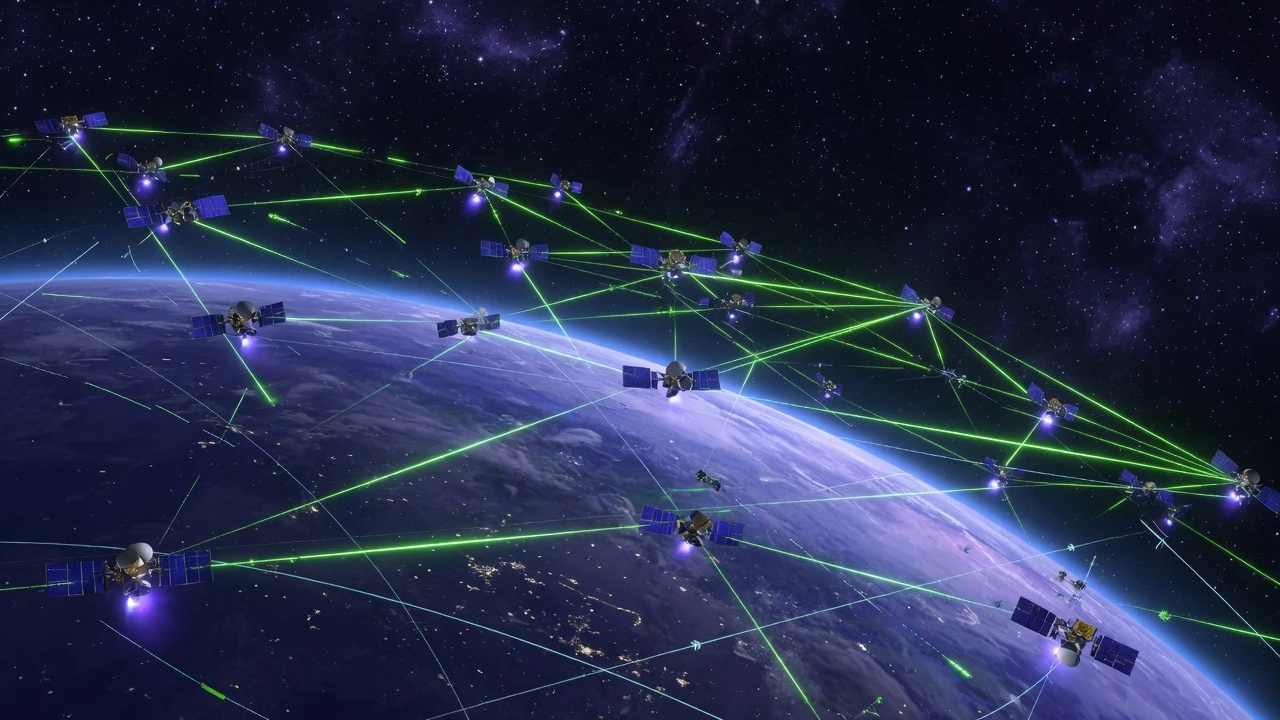
Satellite constellations must account for orbital perturbations — J2 precession, drag, and solar pressure affect station-keeping. - 7
Learn Orbital Plane Changes
Changing orbital plane is extremely expensive in delta-v. A plane change of angle θ at velocity v costs Δv = 2v × sin(θ/2). At LEO velocity (7.7 km/s), a 45° plane change costs 5.9 km/s — more than getting to orbit. Plane changes are best done at apoapsis (lower velocity) or combined with altitude changes (bi-elliptic transfer).
Warning: Plane changes are the most expensive orbital maneuver. Design missions to minimize plane changes — launch into the correct plane rather than changing it later. - 8
Understand Interplanetary Trajectories
Interplanetary missions use: Hohmann transfers (most efficient but slow), fast transfers (more delta-v, shorter time), gravity assists (free delta-v from planets), aerocapture (using atmosphere to slow down). Earth-Mars Hohmann: 258 days, 4.3 km/s. Fast transfer: 130 days, 6+ km/s. Porkchop plots visualize launch windows and delta-v requirements.
textEarth-Mars Transfer Options: Hohmann: 258 days, 4.3 km/s Δv Fast (30%): 180 days, 5.5 km/s Δv Fast (50%): 130 days, 7.0 km/s Δv Opposition: 200 days, 8.5 km/s Δv Launch windows: Every 26 months Next windows: 2026, 2028, 2030... - 9
Apply Orbital Mechanics to Mission Design
Mission design is an optimization problem: minimize delta-v (fuel mass) while meeting constraints (time, launch window, radiation, communication). Tools: NASA GMAT (open-source), AGI STK (commercial), poliastro (Python). Start with Hohmann transfers, add gravity assists for free delta-v, use aerocapture for arrival, and plan orbital insertion carefully.
- 10
Handle Rendezvous and Docking
Rendezvous (two spacecraft meeting in orbit) requires matching both position and velocity. The process: phasing maneuvers (adjusting orbital period to catch up), co-elliptic maneuvers (matching orbit), and final approach (proximity operations). ISS rendezvous takes ~2 days from launch. Automated rendezvous systems (Russian Kurs, SpaceX Dragon) handle the final approach.
Summary
Orbital mechanics is the physics of satellite and spacecraft motion. Key concepts: orbital velocity (sqrt(GM/r)), delta-v budgets (the currency of spaceflight), Hohmann transfers (most efficient orbit changes), gravity assists (free delta-v from planets), and the Oberth effect (burn at maximum velocity for efficiency). Mission design is delta-v optimization under constraints. Understanding these fundamentals is essential for anyone working in space technology.
Frequently Asked Questions
Space travel is about velocity changes, not distance. Once in orbit, you coast — no fuel needed to maintain position. The cost of a maneuver is the delta-v (velocity change), not the distance traveled. A Hohmann transfer to Mars is 258 days of coasting with only two burns.
The spacecraft exchanges momentum with the planet. Approaching from behind the planet's orbit, the spacecraft gains velocity (stealing a tiny amount of the planet's orbital energy). Approaching from ahead, it loses velocity. The planet's mass is so large that the energy change is negligible to it but significant to the spacecraft.
A launch window is the time period when a mission can launch and reach its target with the required trajectory. For Hohmann transfers, windows are brief (minutes to hours) and occur at specific intervals (26 months for Mars). Missing a window means waiting for the next one.
Orbital velocity decreases with altitude (v = sqrt(GM/r)). At 400km, velocity is 7.67 km/s (90-min orbit). At 35,786km (GEO), it is 3.07 km/s (24-hour orbit). This is a direct consequence of gravity being stronger closer to Earth.
Test Your Knowledge
1. What is delta-v in spaceflight?
Delta-v (Δv) is the change in velocity a spacecraft can achieve. It is the "currency" of spaceflight — every maneuver costs delta-v, and the spacecraft has a finite budget determined by its propellant mass.
2. Why is a Hohmann transfer the most efficient orbit change?
A Hohmann transfer uses an elliptical orbit tangent to both the initial and final orbits, requiring only two burns (enter and circularize). It minimizes delta-v at the cost of longer transfer time.
3. What does the Oberth effect tell us?
The Oberth effect: because kinetic energy scales with velocity squared, adding Δv at high velocity (periapsis) gives more energy than the same Δv at low velocity (apoapsis). Always burn at periapsis for maximum efficiency.