How to Build Virtual Power Plants: DER Aggregation and Grid Services
Virtual Power Plants (VPPs) aggregate thousands of distributed energy resources — solar, batteries, EVs, smart thermostats — into a single grid resource. This guide covers architecture, market participation, and the VPP business model.

Introduction
Virtual Power Plants (VPPs) aggregate thousands of distributed energy resources — solar, batteries, EVs, smart thermostats — into a single grid resource. This guide covers architecture, market participation, and the VPP business model.
Prerequisites
- ✓ Understanding of the electric grid
- ✓ Familiarity with distributed energy resources (DERs)
- ✓ Basic knowledge of electricity markets
Key Concepts
Step-by-Step Guide
- 1
Understand the VPP Concept
A VPP is not a physical power plant — it is a software platform that aggregates thousands of small energy resources and controls them as a single entity. A VPP with 50,000 homes (each with solar + battery) can provide 500MW of grid capacity — equivalent to a mid-size power plant. The VPP operator dispatches these resources to provide grid services: capacity, energy arbitrage, frequency regulation, and demand response.
textVPP Aggregation Example: 50,000 homes × 10kW each = 500MW capacity - 30,000 with solar (6kW avg) = 180MW generation - 20,000 with battery (5kW/10kWh) = 100MW/200MWh - 50,000 smart thermostats = 50MW demand reduction - 10,000 EVs (V2G) = 50MW/200MWh Total VPP capacity: ~500MW generation + 500MWh storage Equivalent to: Mid-size gas peaker plant Cost: Fraction of traditional plant - 2
Map VPP Architecture
VPP architecture has 3 layers: 1) Device layer — IoT devices (smart thermostats, battery inverters, EV chargers, solar inverters) with telemetry and control. 2) Communication layer — secure, low-latency connections (cellular, WiFi, mesh) between devices and the cloud. 3) Platform layer — cloud-based VPP software that aggregates, optimizes, and dispatches resources. The platform must handle device diversity, real-time control, market participation, and customer preferences.
Warning: The platform layer is the hard part. It must integrate with diverse devices (different protocols, manufacturers), optimize across thousands of assets in real-time, participate in complex market rules, and respect customer preferences (e.g., "don't discharge my EV battery below 50%"). - 3
Understand VPP Revenue Streams
VPPs earn revenue from: 1) Capacity markets (guaranteed availability — $50-100/kW-year), 2) Energy arbitrage (buy low, sell high — $20-50/kW-year), 3) Frequency regulation (fast response — $10-30/kW-year), 4) Demand response (peak reduction — $20-50/kW-year), 5) Ancillary services (voltage support, reserves — $5-20/kW-year), 6) Renewable integration (curtailment avoidance — varies). Total: $100-250/kW-year from stacked services.
Tip: The most profitable VPPs stack 3+ revenue streams. A residential battery VPP can earn $150-200/kW-year from capacity + arbitrage + frequency regulation. This makes residential batteries economically viable when aggregated. - 4
Navigate FERC Order 2222
FERC Order 2222 (2020) requires all RTOs/ISOs to allow DER aggregations (including VPPs) to participate in wholesale energy, capacity, and ancillary services markets. This is a game-changer — previously, small resources couldn't access wholesale markets. Implementation timeline: 2022-2026 (varies by RTO). Key requirements: minimum size (typically 100kW aggregation), telemetry, dispatchability, and single-node registration. Each RTO is implementing differently — understand local rules.
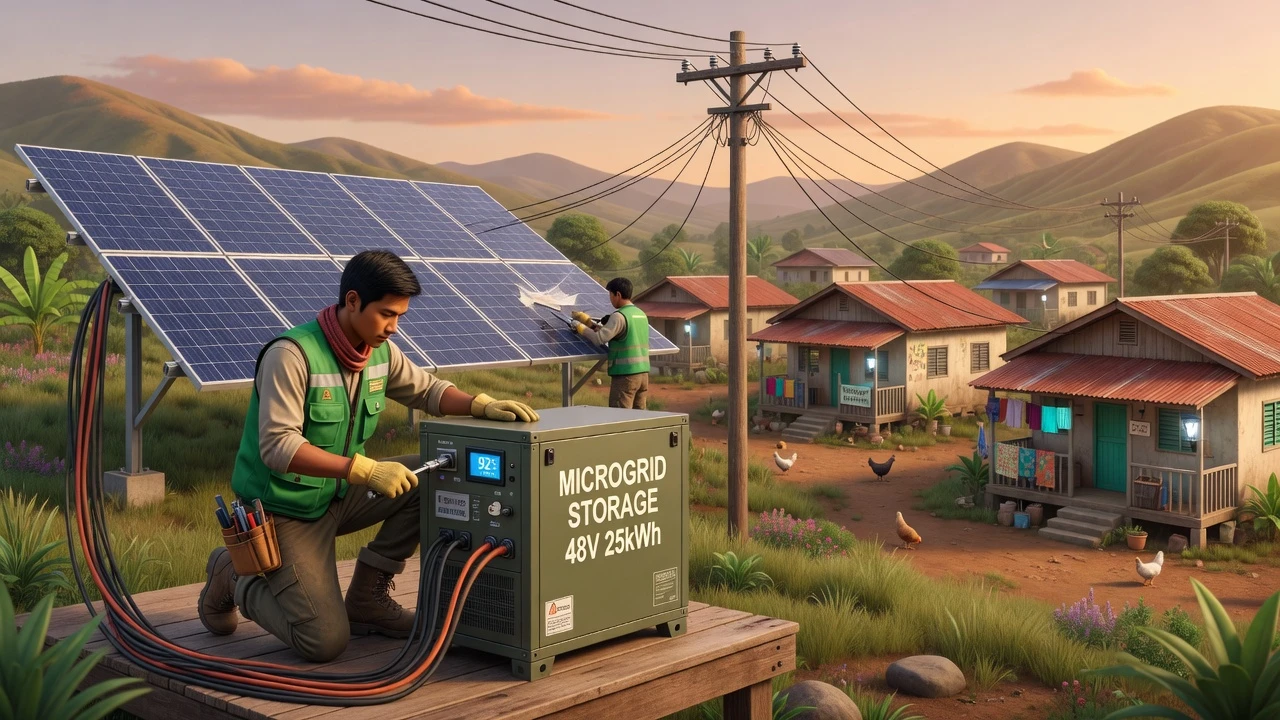
Solar microgrids and distributed resources are the building blocks of virtual power plants — aggregated and controlled via cloud platforms. - 5
Evaluate VPP Business Models
VPP business models: 1) Utility-owned (utility aggregates customer DERs for grid services — e.g., Green Mountain Power Tesla Powerwall program), 2) Third-party aggregator (company aggregates DERs and sells to grid — e.g., Voltus, OhmConnect, Swarm), 3) DER owner self-aggregation (large commercial customers aggregate their own resources), 4) Platform-as-a-service (VPP software company licenses platform to utilities/aggregators — e.g., AutoGrid, EnergyHub). Each model has different capital requirements, regulatory hurdles, and customer relationships.
- 6
Understand Residential VPP Programs
Residential VPPs aggregate home batteries (Tesla Powerwall, Enphase, LG) and smart thermostats. Examples: Tesla VPP (California, 50,000+ Powerwalls), Sunrun VPP (multiple states), Virtual Peaker (utilities). Customers receive $200-500/year for allowing the VPP to dispatch their battery during grid events. Benefits: lower electricity bills, backup power, and grid resilience. Challenges: customer acquisition cost ($500-1,000 per home) and device diversity.
textResidential VPP Economics: Per home: Battery: 5kW/10kWh Powerwall ($12K installed) VPP revenue: $200-500/year Payback: 24-60 years (with VPP alone) With solar + TOU arbitrage: 10-15 years Per VPP (50,000 homes): Capacity: 250MW Revenue: $25-50M/year Platform cost: $2-5M/year Customer acquisition: $25-50M (one-time) Gross margin: 40-60% - 7
Explore EV-to-Grid (V2G) Integration
Electric vehicles are a massive VPP resource — an EV with 60kWh battery has 6x the capacity of a home battery. V2G (Vehicle-to-Grid) allows EVs to discharge to the grid when parked (95% of the time). A VPP aggregating 100,000 EVs (60kWh each) = 6GWh of storage. Challenges: battery degradation concerns, charger compatibility, customer willingness, and regulatory frameworks. Pilots: Fermata Energy, Nuvve, Wallbox. V2G could be the largest VPP resource by 2035.
Warning: EV owners worry that V2G will degrade their battery. Studies show that controlled V2G (limited depth of discharge, avoiding extreme temperatures) causes minimal degradation. But the perception is a barrier — V2G programs must guarantee battery health and provide compensation. - 8
Assess Commercial and Industrial VPPs
C&I VPPs aggregate large loads (HVAC, refrigeration, industrial processes) for demand response. Advantages: fewer, larger assets (lower customer acquisition cost), professional energy managers, and higher per-site revenue ($5,000-50,000/year). Examples: CPower, Voltus, Enel X. C&I VPPs are the most mature segment — demand response programs have operated for 20+ years. FERC Order 2222 expands their market opportunities beyond demand response to capacity and energy markets.
- 9
Understand VPP Technical Challenges
VPP technical challenges: 1) Device diversity (different protocols, APIs, manufacturers — need universal adapters), 2) Communication reliability (cellular/WFi can drop — need local control fallback), 3) Forecasting (predicting available capacity from thousands of unpredictable resources), 4) Dispatch optimization (which devices to activate, when, for how long — complex optimization), 5) Cybersecurity (thousands of endpoints = large attack surface), 6) Latency (frequency regulation requires <1 second response).
Tip: Use open standards (IEEE 2030.5, OpenADR, SunSpec) for device communication. Avoid proprietary protocols that lock you into a single manufacturer. The VPP platform should be device-agnostic. - 10
Project the VPP Market
VPP market: $4B (2026) → $20B+ (2035). Growth drivers: FERC Order 2222 implementation, residential solar+battery growth, EV adoption (V2G), and grid reliability needs. Key players: Tesla (largest residential VPP), Sunrun, Voltus, CPower, AutoGrid, EnergyHub, Stem. Utilities are shifting from opposition to partnership — VPPs defer grid upgrades and provide cheaper capacity than new power plants. The VPP market will grow as DERs proliferate and market rules accommodate aggregations.
Summary
Virtual Power Plants aggregate thousands of distributed energy resources (solar, batteries, EVs, smart thermostats) into a single grid resource controlled by cloud software. VPPs earn $100-250/kW-year from stacked revenue streams (capacity, arbitrage, frequency regulation, demand response). FERC Order 2222 (2020) requires RTOs to allow DER aggregations in wholesale markets — a game-changer. Business models: utility-owned, third-party aggregator, and platform-as-a-service. Key challenges: device diversity, forecasting, dispatch optimization, and cybersecurity. Market: $4B (2026) → $20B+ (2035), driven by DER growth and grid reliability needs.
Frequently Asked Questions
A VPP has no physical generation facility — it aggregates distributed resources (home batteries, EVs, smart thermostats) via software. It provides the same grid services (capacity, energy, frequency regulation) but from thousands of small sources instead of one large plant. VPPs are cheaper, faster to deploy, and more flexible than traditional plants.
Residential: $200-500/year for a home battery (Tesla Powerwall, Sunrun). Commercial: $5,000-50,000/year depending on load size and flexibility. EV V2G: $500-1,500/year (when programs are available). The compensation varies by program, location, and grid event frequency.
FERC Order 2222 (2020) requires all RTOs/ISOs to allow DER aggregations (VPPs) to participate in wholesale energy, capacity, and ancillary services markets. Previously, small resources were excluded. This opens wholesale markets to VPPs — dramatically increasing revenue opportunities. Implementation is ongoing through 2026.
Yes, with V2G (Vehicle-to-Grid) technology. An EV with 60kWh battery has 6x the storage of a home battery. When parked (95% of the time), the EV can discharge to the grid. Challenges: compatible charger, battery degradation concerns, and program availability. V2G pilots are expanding — mass commercialization expected 2028-2032.
Test Your Knowledge
1. What is the primary purpose of a Virtual Power Plant?
A VPP aggregates thousands of small distributed energy resources (solar, batteries, EVs, thermostats) and controls them via cloud software to provide grid services (capacity, energy, frequency regulation) — acting as a single virtual power plant.
2. What did FERC Order 2222 accomplish?
FERC Order 2222 (2020) requires all RTOs/ISOs to allow DER aggregations (VPPs) to participate in wholesale energy, capacity, and ancillary services markets. This opened wholesale markets to small distributed resources — a game-changer for VPP economics.
3. Why is revenue stacking important for VPPs?
A single revenue stream (e.g., energy arbitrage at $20-50/kW-year) cannot justify VPP investment. Stacking 3+ streams (capacity + arbitrage + frequency regulation + demand response = $100-250/kW-year) makes VPPs economically viable. Revenue stacking is the key to profitability.