How to Build a Motor Imagery BCI: Decoding Movement Intentions
A motor imagery BCI decodes imagined movements from brain signals, enabling control of cursors, wheelchairs, and prosthetics without physical movement. This guide builds a complete 4-class motor imagery BCI from data acquisition to real-time control.
Introduction
A motor imagery BCI decodes imagined movements from brain signals, enabling control of cursors, wheelchairs, and prosthetics without physical movement. This guide builds a complete 4-class motor imagery BCI from data acquisition to real-time control.
Prerequisites
- ✓ Neural signal processing basics
- ✓ Python (NumPy, SciPy, MNE-Python)
- ✓ Machine learning (LDA, CSP)
- ✓ Understanding of ERD/ERS
Key Concepts
Step-by-Step Guide
- 1
Design the Paradigm
A good paradigm produces clear, consistent ERD/ERS. Standard 4-class design: 1) Fixation cross (2s), 2) Cue arrow (left/right/feet/tongue) (2s), 3) Motor imagery period (4s), 4) Rest (2s). Randomize trial order. 30-50 trials per class (120-200 total). Record from C3, Cz, C4 (motor cortex) plus surrounding electrodes (FC3, FCz, FC4, CP3, CPz, CP4). Use 10-20 or 10-10 system placement.
textMotor Imagery Paradigm: Trial structure: 0-2s: Fixation cross (+) 2-4s: Cue arrow (←/→/↓/↑) 4-8s: Motor imagery (imagine movement) 8-10s: Rest (blank screen) Classes: Left hand, Right hand, Feet, Tongue Trials: 30-50 per class (120-200 total) Channels: C3, Cz, C4 + neighbors Sampling: 250 Hz Duration: ~30-40 min total - 2
Acquire EEG Data
Use a research-grade EEG system (32-64 channels, 250+ Hz). Wet electrodes with impedance <5 kΩ. Place electrodes per 10-20 system with focus on motor cortex (C3, Cz, C4). Reference: earlobes or mastoids. Ground: Fpz. Record triggers on cue onset for epoching. Open datasets: BCI Competition IV (Dataset 2a: 4-class MI, 9 subjects), PhysioNet EEGMMIDB.
Tip: BCI Competition IV Dataset 2a is the standard benchmark for 4-class motor imagery. 9 subjects, 4 classes (left, right, feet, tongue), 22 channels, 250 Hz, 288 trials per subject. Use this to validate your pipeline before collecting your own data. - 3
Preprocess the Data
Steps: 1) Bandpass filter 8-30 Hz (mu + beta bands — most discriminative for MI), 2) Notch filter 50/60 Hz, 3) Common Average Reference (CAR), 4) Epoch: extract 0.5-3.5s after cue onset (imagery period), 5) Baseline correction (-0.5 to 0s). Keep only motor cortex channels (C3, Cz, C4 + neighbors) to reduce dimensionality.
pythonimport mne import numpy as np # Load raw EEG raw = mne.io.read_raw_gdf("subject1.gdf", preload=True) # Filter 8-30 Hz (mu + beta) raw.filter(8, 30, method="fir") # Notch 50 Hz (Europe) or 60 Hz (US) raw.notch_filter(50) # Common Average Reference raw.set_eeg_reference("average") # Epoch: 0.5 to 3.5s after cue events, _ = mne.events_from_annotations(raw) epochs = mne.Epochs(raw, events, tmin=0.5, tmax=3.5, baseline=(None, 0), preload=True) # Select motor cortex channels channels = ["C3", "Cz", "C4", "FC3", "FCz", "FC4", "CP3", "CPz", "CP4"] epochs = epochs.pick_channels(channels) - 4
Extract CSP Features
CSP finds spatial filters that maximize variance differences between classes. For 4-class: use One-vs-Rest CSP or pairwise CSP + voting. Extract log-variance features from CSP-filtered data. Typical: 4-6 CSP components per class. The CSP + log-variance + LDA pipeline achieves 70-85% accuracy on BCI Competition IV Dataset 2a.
pythonfrom mne.decoding import CSP from sklearn.discriminant_analysis import LinearDiscriminantAnalysis from sklearn.pipeline import Pipeline from sklearn.model_selection import cross_val_score # CSP + LDA pipeline csp = CSP(n_components=6, reg="empirical", log=True) lda = LinearDiscriminantAnalysis(solver="lsqr", shrinkage="auto") clf = Pipeline([("csp", csp), ("lda", lda)]) # Get data and labels X = epochs.get_data() # (n_trials, n_channels, n_samples) y = epochs.events[:, -1] # class labels # Cross-validated accuracy scores = cross_val_score(clf, X, y, cv=5, scoring="accuracy") print(f"Accuracy: {scores.mean():.2f} ± {scores.std():.2f}") # Typical: 0.70-0.85 on BCI Competition IV - 5
Train and Evaluate the Classifier
LDA with shrinkage is the standard classifier for motor imagery BCIs — fast, robust, and works well with small datasets. For 4-class: use multi-class LDA (one-vs-rest). Alternatives: SVM (RBF kernel, tune C and gamma), Random Forest, or EEGNet (deep learning, needs more data). Always use cross-validation: 5-fold or leave-one-trial-out. Report mean ± std accuracy. Chance level for 4-class: 25%. Usable: >50%. Good: >70%. Excellent: >85%.
Warning: Never report training accuracy! A CSP+LDA pipeline can achieve 99% training accuracy but only 70% cross-validated accuracy. Always use k-fold cross-validation. For BCI, consider within-session (optimistic), cross-session (realistic), and cross-subject (hardest) evaluation. Cross-session accuracy is the most practical metric. - 6
Optimize the Pipeline
Techniques to improve accuracy: 1) Filter bank CSP — multiple CSP filters on different frequency bands (8-12, 12-16, 16-20, 20-24, 24-28 Hz), combine features. Improves accuracy 5-10%. 2) Channel selection — use only the most discriminative channels (recursive feature elimination). 3) Time window optimization — try different epoch lengths (2s, 3s, 4s). 4) Subject-specific frequency bands — find individual mu/beta peaks. 5) Riemannian geometry — classify covariance matrices directly, often outperforms CSP+LDA by 5-10%.
python# Filter Bank CSP (FBCSP) — multiple frequency bands from mne.decoding import CSP bands = [(8,12), (12,16), (16,20), (20,24), (24,28)] features = [] for fmin, fmax in bands: raw_filtered = raw.copy().filter(fmin, fmax) epochs_f = mne.Epochs(raw_filtered, events, tmin=0.5, tmax=3.5) csp = CSP(n_components=4, log=True).fit(epochs_f.get_data(), y) features.append(csp.transform(epochs_f.get_data())) X_fbcsp = np.concatenate(features, axis=-1) # combined features # Then classify with LDA or SVM - 7
Implement Real-Time Control
For online BCI: 1) Train classifier on calibration data (10 min), 2) Open EEG stream, 3) Sliding window (2-3s buffer, updated every 0.5s), 4) Preprocess → CSP → LDA → command, 5) Output to application (cursor, wheelchair, robotic arm). Use MNE-Python for real-time processing or OpenViBE for a complete BCI platform. Latency: 200-500ms. Add visual feedback (cursor moves based on classification).
python# Real-time motor imagery BCI (pseudo-code) import collections import time buffer = collections.deque(maxlen=750) # 3s at 250 Hz csp_model = csp.fit(X_cal, y_cal) # trained on calibration lda_model = lda.fit(csp_model.transform(X_cal), y_cal) while True: sample = eeg_stream.get_sample() buffer.append(sample) if len(buffer) == 750: epoch = preprocess(np.array(buffer).T) features = csp_model.transform(epoch[None]) prediction = lda_model.predict(features) confidence = lda_model.predict_proba(features).max() if confidence > 0.6: # only act on confident predictions send_command(prediction) time.sleep(0.5) # update every 0.5s - 8
Handle Subject Variability
Not everyone can use motor imagery BCIs. 5-20% of users are "BCI illiterate" (<60% accuracy). Causes: weak ERD, poor imagery ability, attention issues. Solutions: 1) Subject-specific calibration (always), 2) Alternative paradigms (P300, SSVEP) for illiterate users, 3) Neurofeedback training (practice motor imagery with feedback), 4) Hybrid BCIs (MI + P300), 5) Transfer learning (use data from good subjects to help poor ones).
Tip: Neurofeedback training can improve BCI performance. Show users their ERD in real-time (brainwave visualization). With 3-5 training sessions, many "illiterate" users improve to >70% accuracy. The brain can learn to produce more discriminable patterns with practice — neurofeedback is the training tool. - 9
Deploy the BCI System
Deployment options: 1) Research — MNE-Python + custom application, 2) Clinical — OpenViBE or BCI2000 (FDA-compatible), 3) Consumer — OpenBCI + custom app. Consider: calibration time (5-10 min), session duration (30-60 min before fatigue), comfort (cap fit, gel), and user training. For clinical use (ALS, stroke rehab): work with clinicians, get IRB approval, and follow FDA guidelines for medical device software.
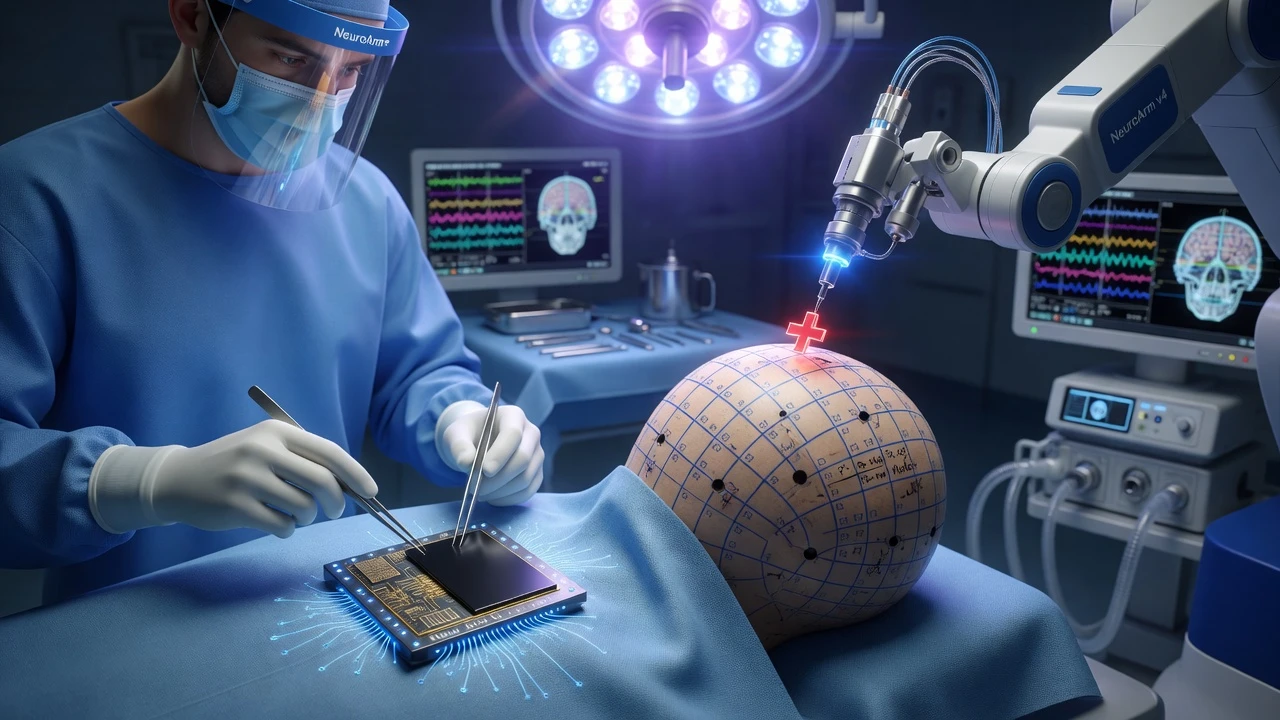
Motor imagery BCIs can control prosthetic limbs — decoding imagined hand movements to actuate robotic arms.
Summary
A motor imagery BCI decodes imagined movements (left hand, right hand, feet, tongue) from EEG. Pipeline: paradigm design (trial-based, 30-50 trials/class) → preprocess (8-30 Hz bandpass, CAR) → CSP spatial filtering (4-6 components) → log-variance features → LDA classifier → real-time control (200-500ms latency). Standard accuracy: 70-85% (4-class). Optimizations: filter bank CSP (+5-10%), Riemannian geometry (+5-10%), subject-specific calibration. Challenges: 5-20% BCI illiteracy, non-stationarity, and calibration burden. Use BCI Competition IV Dataset 2a for benchmarking.
Frequently Asked Questions
4-class: 70-85% (cross-validated, within-session). 2-class: 80-95%. Cross-session: 5-10% lower. Cross-subject: 10-20% lower (without calibration). 5-20% of users ("BCI illiterate") achieve <60%. Filter bank CSP and Riemannian methods can improve accuracy 5-10%.
Minimum: 30 trials per class (120 for 4-class). Recommended: 50-80 per class (200-320 total). More trials improve classifier training but cause fatigue. Balance data quantity with session duration (30-60 min max). Use data augmentation (trial cropping, noise injection) for small datasets.
Yes — EEGNet (depthwise + separable convolutions) achieves comparable or better accuracy than CSP+LDA on some datasets. Advantages: no manual feature engineering, learns subject-specific features. Disadvantages: needs more data (500+ trials), harder to interpret, slower for online use. Best for offline analysis; CSP+LDA remains preferred for real-time.
BCI Competition IV Dataset 2a: 9 subjects, 4 classes (left, right, feet, tongue), 22 channels, 250 Hz, 288 trials/subject. The standard benchmark. Also: PhysioNet EEGMMIDB (109 subjects, 64 channels), High-Gamma Dataset (BCI competition winners).
Test Your Knowledge
1. What is the standard pipeline for a motor imagery BCI?
The standard MI BCI pipeline: bandpass filter (8-30 Hz) → CSP spatial filtering → log-variance features → LDA classifier. This achieves 70-85% on 4-class tasks. CSP maximizes class-discriminative variance; LDA is fast and robust for online use.
2. What percentage of users are "BCI illiterate"?
5-20% of users cannot achieve >60% accuracy on motor imagery BCIs despite training. Causes: weak ERD, poor imagery ability, attention. Solutions: neurofeedback training, alternative paradigms (P300, SSVEP), and hybrid BCIs.
3. What is filter bank CSP (FBCSP)?
FBCSP applies CSP separately to multiple frequency bands (e.g., 8-12, 12-16, 16-20, 20-24, 24-28 Hz) and combines the features. This captures subject-specific discriminative frequencies and improves accuracy 5-10% over standard CSP.