How the Nuclear Fuel Cycle Works: From Mining to Disposal
The nuclear fuel cycle — from uranium mining to waste disposal — is a complex chain of industrial processes. This guide covers each stage, from open vs closed cycles to waste management strategies.
Introduction
The nuclear fuel cycle — from uranium mining to waste disposal — is a complex chain of industrial processes. This guide covers each stage, from open vs closed cycles to waste management strategies.
Prerequisites
- ✓ Basic nuclear physics (fission, isotopes)
- ✓ Understanding of nuclear reactor operation
- ✓ General knowledge of nuclear industry
Key Concepts
Step-by-Step Guide
- 1
Understand the Front-End: Mining and Milling
Uranium mining: open-pit (shallow deposits), underground (deep deposits), or in-situ recovery (ISR — dissolve uranium in groundwater and pump to surface). ISR is now 60% of global production (lowest cost, smallest footprint). Top producers: Kazakhstan (43%), Canada (15%), Namibia (11%), Australia (10%). Milling converts ore to yellowcake (U3O8, ~80% uranium). Global production: ~60,000 tonnes U/year, meeting ~90% of demand (remainder from stockpiles and downblending).
Tip: Kazakhstan dominates uranium mining via ISR (in-situ recovery) — low cost ($30-40/lb) and low environmental impact. This is why uranium prices have been relatively stable despite geopolitical concerns. - 2
Learn Conversion and Enrichment
Conversion: yellowcake (U3O8) → uranium hexafluoride (UF6) — the feedstock for enrichment. Facilities: ConverDyn (US), Orano (France), Cameco (Canada), Rosatom (Russia). Enrichment: increase U-235 from 0.7% to 3-5% (LWR fuel). Technologies: gas centrifuge (dominant — 95%+ of capacity), laser enrichment (SILEX, emerging). Enrichment capacity: ~60M SWU/year globally. SWU (Separative Work Unit) measures enrichment effort.
textEnrichment Levels: Natural uranium: 0.7% U-235 LEU (LWR fuel): 3-5% U-235 HALEU: 5-20% U-235 HEU (weapons): 90%+ U-235 Enrichment effort (SWU per kg): 0.7% → 3.5%: ~4.5 SWU/kg 0.7% → 5%: ~7.5 SWU/kg 0.7% → 20%: ~30 SWU/kg 0.7% → 90%: ~200 SWU/kg - 3
Understand Fuel Fabrication
Enriched UF6 is converted to UO2 (uranium dioxide) powder, pressed into pellets, sintered at 1,700°C, and loaded into zirconium alloy tubes (fuel rods). Rods are assembled into fuel assemblies (17x17 for PWR, 8x8 for BWR). A typical 1GWe reactor uses ~27 tonnes of enriched uranium per year (3 fuel batches, refueled every 18 months). Fuel fabrication facilities: Westinghouse (US), Framatome (France), Global Nuclear Fuel (US/Japan), TVEL (Russia).
- 4
Understand Reactor Operation
In the reactor, U-235 fissions produce heat (used for electricity) and neutrons (sustain chain reaction). Fuel stays in the reactor for 3-6 years (3 cycles of ~18 months). By the end, ~3-5% of the uranium has fissioned. The spent fuel contains: ~95% U-238 (unused), ~1% U-235 (remaining), ~1% Pu-239 (bred from U-238), and ~3% fission products (highly radioactive waste). A 1GWe reactor produces ~27 tonnes of spent fuel per year.

Reactor control rooms monitor fuel performance, neutron flux, and thermal margins throughout the fuel cycle. - 5
Compare Open vs Closed Fuel Cycles
Open cycle (US, Sweden, Finland, Canada): mine → enrich → burn → store spent fuel in casks → eventually dispose in DGR. Simple, no proliferation risk from reprocessing, but wastes 95% of uranium energy content. Closed cycle (France, Russia, UK, Japan): mine → enrich → burn → reprocess spent fuel → recycle U and Pu → burn again → dispose fission products. Uses 60-100% of uranium energy content, reduces waste volume 5x, but creates proliferation concerns (separated plutonium).
Warning: The US abandoned reprocessing in 1977 (Carter policy) due to proliferation concerns. France has reprocessed for 50+ years without proliferation issues. The policy debate continues — Gen-IV fast reactors require a closed cycle. - 6
Understand Reprocessing
Reprocessing (PUREX process): dissolve spent fuel in nitric acid, extract uranium (for re-enrichment), plutonium (for MOX fuel), and separate fission products (for vitrification). MOX (Mixed Oxide) fuel: combines PuO2 and UO2 — can fuel LWRs (up to 30% MOX) or fast reactors (100% MOX). France reprocesses ~1,000 tonnes/year at La Hague. Global reprocessing capacity: ~4,000 tonnes/year. The UK's Thorp facility closed in 2022.
Tip: PUREX is the only commercially proven reprocessing technology. It was developed for weapons plutonium production and has been used commercially for 60+ years. Alternative processes (UREX+, pyroprocessing) are being developed for proliferation resistance. - 7
Manage High-Level Waste (HLW)
Spent fuel (or vitrified fission products from reprocessing) is high-level waste: extremely radioactive and thermally hot (2kW/tonne initially). Management: pool storage (first 5-10 years, water cooling), dry cask storage (10-50 years, passive air cooling), and deep geological repository (permanent). Only two DGRs under construction: Onkalo (Finland, 2025 operation) and Forsmark (Sweden, 2028). The US Yucca Mountain project was cancelled. Interim storage: ISFSIs (Independent Spent Fuel Storage Installations) at reactor sites.
textNuclear Waste topics: HLW (High-Level): Spent fuel, vitrified waste Volume: ~3% of total, 95% of radioactivity Heat: 2 kW/tonne (initially) Disposal: Deep Geological Repository ILW (Intermediate): Reactor components, resins Disposal: Near-surface or intermediate depth LLW (Low-Level): Tools, clothing, filters Disposal: Shallow land burial VLLW (Very Low-Level): Soil, rubble Disposal: Limited landfill - 8
Understand Deep Geological Repositories
A DGR isolates HLW for 100,000+ years using multiple barriers: waste form (UO2 or vitrified glass — durable), canister (copper/cast iron or stainless steel — 100K+ year corrosion life), buffer (bentonite clay — swells to seal cracks), host rock (crystalline basement or clay — stable for millions of years). Onkalo (Finland): 450m depth in crystalline bedrock, copper canisters, bentonite buffer. First disposal planned for 2025. Total cost: €3.5B, funded by waste producers.
Warning: No DGR has yet received waste (Onkalo will be first in 2025). The US spent $15B on Yucca Mountain before cancelling it. DGR siting is politically challenging — Finland succeeded through community consent and transparent process. - 9
Evaluate Waste Reduction Strategies
Waste reduction options: 1) Closed fuel cycle (reprocess — reduces volume 5x, but creates separated Pu), 2) Fast reactor actinide burning (fissions transuranics — reduces radiotoxicity from 100K+ to ~300 years), 3) Partitioning and transmutation (separate long-lived isotopes and transmute in accelerator or reactor), 4) Advanced fuels ( Accident Tolerant Fuels — higher burnup, less waste). The most impactful is fast reactor burning — it addresses both waste lifetime and fuel supply.
- 10
Assess Transportation and Security
Nuclear material transport: uranium concentrate (yellowcake — low hazard), enriched UF6 (moderate — chemical hazard), fresh fuel (low — before irradiation), spent fuel (high — shielded casks). Spent fuel casks: 100+ tonne steel/lead/concrete, survive 30m drop, 800°C fire, and water immersion. Transport by rail and road. Security: armed guards, route confidentiality, and satellite tracking. No major incident in 60+ years of nuclear transport.
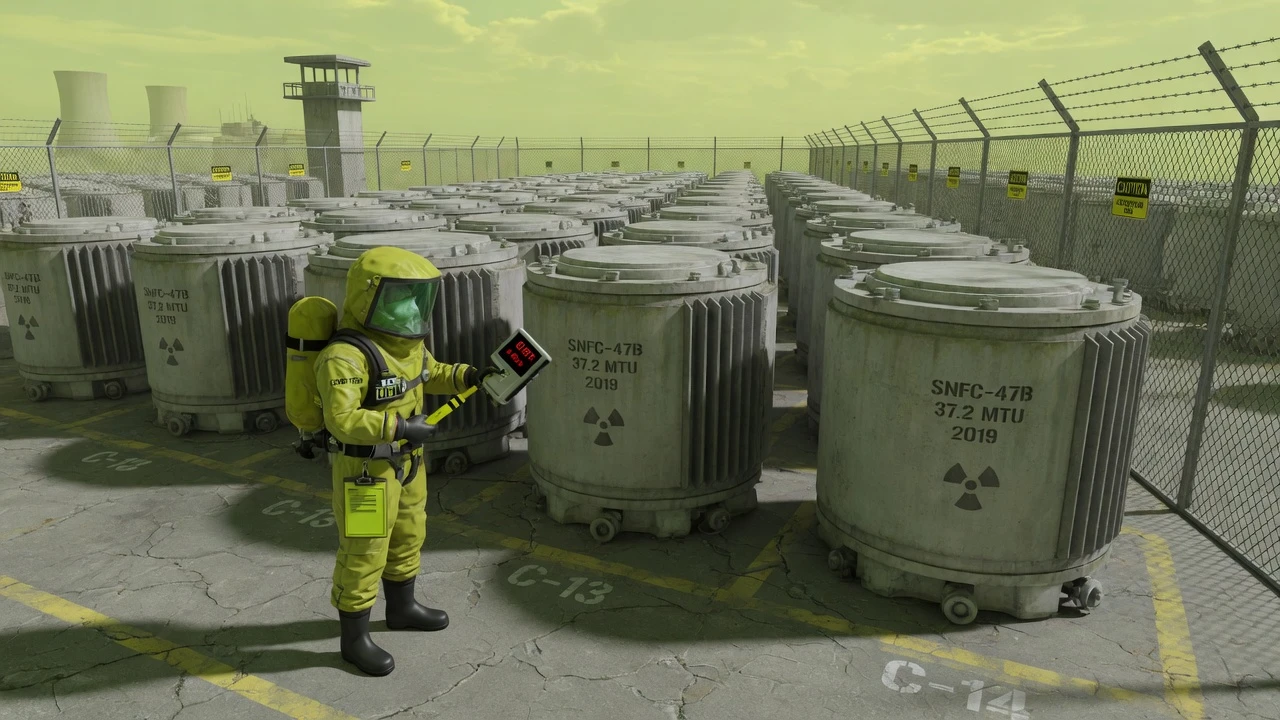
Spent fuel dry casks provide passive cooling and radiation shielding for decades of interim storage. - 11
Plan for the Future Fuel Cycle
The future fuel cycle depends on Gen-IV deployment: If Gen-IV fast reactors deploy widely, a closed fuel cycle with reprocessing and actinide burning is needed. If LWRs continue to dominate, the open cycle with DGR remains viable. Key decisions: reprocessing policy (proliferation vs waste reduction), HALEU supply (for advanced reactors), and DGR siting (Finland leads, US lags). The fuel cycle is a 100-year decision — choices made now affect waste management for generations.
Summary
The nuclear fuel cycle spans uranium mining (Kazakhstan 43%), enrichment (gas centrifuge, 3-5% U-235), fuel fabrication, reactor operation (3-5% burnup), and waste management. The open cycle (US) stores spent fuel and wastes 95% of energy content. The closed cycle (France) reprocesses to recover U and Pu, reducing waste 5x but creating proliferation concerns. High-level waste requires a Deep Geological Repository — Onkalo (Finland) will be the first in 2025. Gen-IV fast reactors with closed cycles could reduce waste lifetime from 100K+ to ~300 years and extend fuel supply to thousands of years. The fuel cycle is a 100-year strategic decision.
Frequently Asked Questions
President Carter banned reprocessing in 1977 due to proliferation concerns (separated plutonium). The ban was lifted by Reagan, but no commercial reprocessing plant was built due to economics — uranium was cheaper than reprocessing. The US remains committed to the open fuel cycle, though Gen-IV fast reactors would require reprocessing.
Spent fuel radiotoxicity drops to uranium ore levels after ~100,000 years (open cycle). With actinide burning in fast reactors, it drops to ore levels in ~300 years. Fission products (the actual waste in a closed cycle) mostly decay within 500 years — only a few long-lived isotopes (I-129, Cs-135) persist longer.
MOX (Mixed Oxide) fuel combines plutonium dioxide (from reprocessing) with uranium dioxide. It can replace up to 30% of LWR fuel or 100% of fast reactor fuel. France uses MOX in 20+ reactors. MOX reduces plutonium stockpiles (proliferation benefit) and extends uranium resources.
Onkalo in Finland is expected to begin disposal operations in 2025 — the world's first DGR for spent fuel. Sweden's Forsmark is expected around 2028. The US cancelled Yucca Mountain and has no current DGR plan — spent fuel remains in dry casks at reactor sites.
Test Your Knowledge
1. What is the difference between open and closed nuclear fuel cycles?
Open cycle: once-through fuel use — burn uranium, store spent fuel. Closed cycle: reprocess spent fuel to recover uranium (re-enrich) and plutonium (MOX fuel), then burn again. Closed cycle uses 60-100% of uranium energy content (vs 1-5% for open) but creates proliferation concerns from separated plutonium.
2. What percentage of natural uranium is fissile U-235?
Natural uranium contains 0.7% U-235 (fissile) and 99.3% U-238 (fertile). Enrichment increases U-235 to 3-5% for LWR fuel, 5-20% for HALEU (advanced reactors), or 90%+ for weapons. The enrichment effort (SWU) increases dramatically with target assay.
3. What is the purpose of a Deep Geological Repository?
A DGR isolates HLW using multiple engineered and natural barriers: waste form (durable UO2 or glass), canister (copper/steel, 100K+ year life), buffer (bentonite clay), and host rock (stable crystalline or clay formation). Onkalo (Finland) will be the first operational DGR in 2025.