How Inertial Confinement Fusion Works: Lasers, Targets, and Ignition
Inertial Confinement Fusion (ICF) uses the world's most powerful lasers to compress a fuel pellet to extreme densities, triggering fusion. In December 2022, NIF achieved Q>1 — scientific breakeven. This guide covers hohlraum design, implosion physics, and the path to ignition.
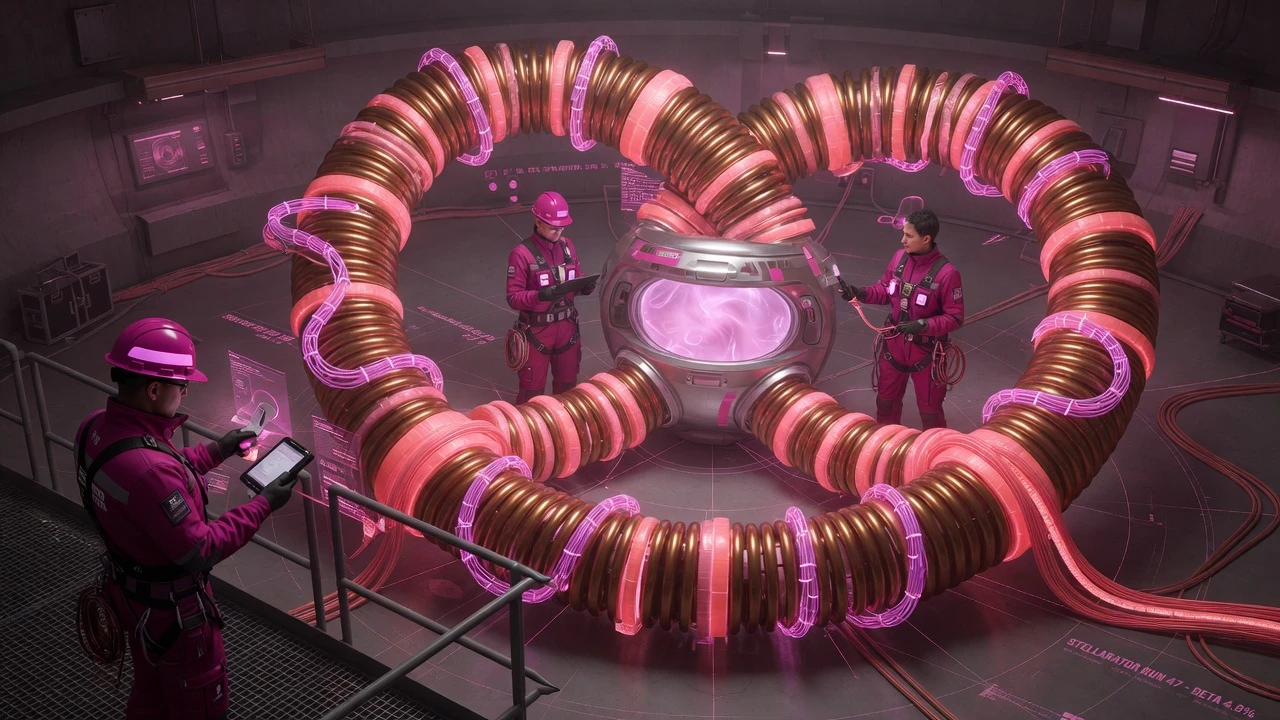
Introduction
Inertial Confinement Fusion (ICF) uses the world's most powerful lasers to compress a fuel pellet to extreme densities, triggering fusion. In December 2022, NIF achieved Q>1 — scientific breakeven. This guide covers hohlraum design, implosion physics, and the path to ignition.
Prerequisites
- ✓ Basic nuclear physics
- ✓ Optics and laser physics
- ✓ Thermodynamics
- ✓ High-energy-density physics basics
Key Concepts
Step-by-Step Guide
- 1
Understand ICF Principles
ICF compresses a 2mm D-T pellet using lasers. Three phases: 1) Ablation — laser heats capsule surface, causing outward rocket effect, 2) Compression — capsule implodes to 100x solid density, 3) Ignition — hot spot reaches 5-10 keV, burn propagates outward. The entire process takes ~100 nanoseconds.
textICF Timeline: T=0: Laser fires (2.05 MJ UV) T=1ns: Hohlraum → X-rays (~300 eV) T=5ns: Capsule ablates, implodes T=15ns: Peak compression (100x density) T=20ns: Hot spot ignites (5-10 keV) T=50ns: Burn wave propagates T=100ns: Fuel disassembles NIF Dec 5 2022: 3.15 MJ from 2.05 MJ (Q=1.5) - 2
Master Direct vs Indirect Drive
Direct drive: lasers hit pellet directly (simpler, 30-40% efficient, but needs extremely uniform illumination). Indirect drive: lasers hit hohlraum → X-rays → pellet (more uniform, but only ~15% efficient). NIF uses indirect drive (better symmetry for weapons physics). Direct drive pursued at University of Rochester (OMEGA).
Tip: Direct drive may be better for energy production — higher coupling efficiency and simpler targets. But it requires extremely uniform laser illumination (beam smoothing) to avoid asymmetric implosion. - 3
Understand the Hohlraum
The hohlraum is a gold/uranium cylinder (~1cm) converting laser light to thermal X-rays. Lasers enter through holes, heat walls to ~300 eV (3.5M K), walls emit X-rays filling the cavity, uniformly illuminating the capsule. Design is critical — entrance holes, wall material, and geometry determine symmetry and efficiency.
Warning: Laser-plasma instabilities (LPI) can scatter 10-30% of laser energy. Backscatter (SBS, SRS) and cross-beam energy transfer (CBET) reduce efficiency and create asymmetry. These were major challenges for NIF ignition. - 4
Understand Implosion Physics
Implosion must be highly symmetric (velocity uniformity <1%) and stable. Key instabilities: 1) Rayleigh-Taylor (dense shell decelerating against lighter hot spot), 2) Richtmyer-Meshkov (shock-induced mixing), 3) Ablation front instability. These mix cold material into the hot spot, quenching ignition. Mitigation: <1nm surface roughness, precise 4-shock timing, hohlraum symmetry tuning.
NIF plasma diagnostics — measuring X-ray emission, temperature, and density with picosecond precision. - 5
Achieve Ignition
Ignition requires hot spot ρR > 0.3 g/cm² at T > 5 keV. Alpha particles (3.5 MeV) must deposit energy within the fuel (range ~0.3 g/cm²). NIF Dec 5, 2022: 3.15 MJ fusion from 2.05 MJ laser (Q=1.5). Hot spot: ~11 keV, ρR ~1.3 g/cm², compressed to ~50 microns from 2mm. First controlled fusion ignition in the laboratory.
textNIF Ignition (Dec 5, 2022): Laser: 2.05 MJ (192 beams, 351nm UV) Fusion: 3.15 MJ (Q=1.5) Hot spot: ~11 keV, 50-100 g/cm³ Areal density: ~1.3 g/cm² Compressed: ~50 microns (from 2mm) Compression: ~100x solid density - 6
Understand NIF Architecture
NIF at Lawrence Livermore National Lab: 192 beams, each ~40cm square, 1.8 MJ of 351nm UV in 20ns. Neodymium glass amplifiers. Path: oscillator → preamps → main amps → power amps → frequency conversion → target chamber (10m). Facility: 3 football fields, $3.5B. Shot rate: 1/day (power plant needs 10+/sec).
Warning: NIF was built for weapons stewardship, not energy. Lasers are <1% efficient. A power plant needs diode-pumped lasers (10-15% efficiency) and 10+ Hz repetition rate. The gap is enormous — 30-50 years of engineering. - 7
Explore Laser Alternatives
Beyond NIF glass lasers: 1) Diode-pumped solid-state (DPSSL) — 10-15% efficiency, 10+ Hz, but lower energy/pulse. Developed for ICF energy (Mercury, Hiper). 2) KrF gas lasers — shorter wavelength (248nm), better coupling, lower efficiency. 3) Pulsed power (Z-machine) — X-rays from Z-pinch, higher efficiency, lower precision. DPSSL is most promising for ICF energy.
Tip: Key metric: wall-plug efficiency. NIF: <1% (flashlamp-pumped). DPSSL: 10-15% (diode-pumped). At 10% efficiency and 10 Hz, a 1 MJ laser needs 100 MW wall-plug for 100 MJ/s fusion — marginal for a power plant. - 8
Understand Target Fabrication
ICF targets: 2mm capsules with <1nm surface roughness, D-T ice uniformity <1 micron, concentricity <1 micron. Manufacturing: mandrel (plastic/diamond) → fill with D-T through 10-micron tube → cool to form ice layer (beta-layering) → characterize. Cost: ~$100K each (NIF). Power plant at 10 Hz: 864,000 targets/day — cost must drop to <$0.10.
Warning: Target fabrication at power-plant scale is a showstopper. NIF targets cost $100K and take months. A power plant needs 864,000/day at <$0.10 each. Mass production of near-perfect 2mm capsules has never been demonstrated. - 9
Assess ICF for Energy
ICF power plant challenges: 1) Laser efficiency (<1% → 10-15%), 2) Repetition rate (1/day → 10+/sec), 3) Target cost ($100K → <$0.10), 4) Chamber survival (repeated explosions at 10 Hz), 5) Tritium breeding, 6) Thermal cycle. Several designs exist (Hylife, KOYO) but none built. ICF energy likely 2065+ — well behind magnetic fusion.
textICF: NIF vs Power Plant: Parameter | NIF | Power Plant Laser energy | 2 MJ | 1-5 MJ Laser efficiency| <1% | 10-15% Repetition rate| 1/day | 10-20 Hz Targets/day | 1 | 864K-1.7M Target cost | $100K | <$0.10 Q (gain) | 1.5 | >100 Wall-plug Q | <0.01 | >10 - 10
Compare ICF with Magnetic Fusion
ICF: pulsed (explosions), higher density (1000x solid), nanosecond confinement. Magnetic: continuous (plasma), low density (10⁻⁶ solid), second-scale confinement. ICF Q=1.5 (NIF); magnetic Q=0.67 (JET). For energy: magnetic fusion is closer (ITER Q=10 in 2040s, power plant 2045-2055). ICF power plants: 2065+. ICF's primary value: weapons physics and high-energy-density science.
Tip: ICF and magnetic fusion are complementary. ICF studies high-density, short-time fusion (weapons, astrophysics). Magnetic fusion studies low-density, long-time fusion (energy production). For energy, magnetic fusion is the clear front-runner. - 11
Project the ICF Future
ICF roadmap: NIF ignition achieved (2022). Next: higher Q shots, repeatable ignition, improved hohlraum. Laser development: DPSSL for high rep rate. ICF energy: LIFE concept proposed but not funded. Power plant: 2065+ at earliest. ICF will continue advancing weapons science and HED physics. For energy, ICF is a long-term bet — magnetic fusion and HTS compact tokamaks are much closer.
Warning: Do not confuse NIF ignition with practical fusion energy. NIF Q=1.5 is a scientific milestone. The gap to a power plant: 100x laser efficiency, 1 million times repetition rate, 1 million times cheaper targets. ICF energy is decades behind magnetic fusion energy.
Summary
ICF compresses a 2mm D-T pellet using 192 lasers (NIF), achieving ignition on Dec 5, 2022 (Q=1.5, 3.15 MJ from 2.05 MJ). Process: laser → hohlraum → X-rays → ablation → implosion → ignition → burn. Key physics: Rayleigh-Taylor instability, hohlraum symmetry, alpha heating. NIF is a weapons facility, not an energy device. ICF power plants face enormous challenges: laser efficiency (<1% → 10-15%), repetition rate (1/day → 10+ Hz), target cost ($100K → <$0.10). ICF energy: 2065+. Magnetic fusion is the practical path to grid power.
Frequently Asked Questions
Yes. December 5, 2022: 3.15 MJ fusion from 2.05 MJ laser (Q=1.5). This exceeded scientific breakeven. Alpha heating sustained the reaction — true ignition. A historic first for controlled fusion.
Not in the near term. NIF lasers are <1% efficient, fire 1 shot/day, and targets cost $100K each. A power plant needs 10-15% efficiency, 10+ Hz, and <$0.10 targets. ICF energy is 2065+ at earliest. Magnetic fusion is much closer.
The hohlraum converts laser light to X-rays for uniform pellet illumination. Direct laser illumination (direct drive) creates asymmetry. The hohlraum provides a uniform radiation bath but at the cost of efficiency (~15% coupling vs 30-40% for direct drive).
NIF was built for the Stockpile Stewardship Program — verifying nuclear weapons without testing. ICF physics (compression, ignition, burn propagation) is directly relevant to thermonuclear weapons. Energy production is a secondary goal that has not received dedicated funding.
Test Your Knowledge
1. What is the hohlraum?
The hohlraum is a gold/uranium cylinder. Lasers hit its inner walls, heating them to ~300 eV. The walls emit X-rays that uniformly illuminate the fuel capsule — providing the symmetry needed for implosion.
2. What Q did NIF achieve in December 2022?
NIF produced 3.15 MJ of fusion energy from 2.05 MJ of laser energy — Q=1.5. This was the first time controlled fusion exceeded the energy delivered to the target. A historic scientific milestone.
3. Why is ICF not practical for energy production?
NIF lasers are <1% efficient (need 10-15%), fire once per day (need 10+ Hz), and targets cost $100K (need <$0.10). These are million-fold gaps. ICF energy is decades away. Magnetic fusion is the practical path.