How Fusion Will Reach the Grid: From Q>1 to Commercial Power Plants
Fusion has achieved scientific breakeven (NIF Q=1.5) and is approaching engineering breakeven (CFS SPARC, Q>1 by 2027). But the path from Q>1 to a commercial power plant involves tritium breeding, materials qualification, regulatory frameworks, and economic viability. This guide maps the complete roadmap.

Introduction
Fusion has achieved scientific breakeven (NIF Q=1.5) and is approaching engineering breakeven (CFS SPARC, Q>1 by 2027). But the path from Q>1 to a commercial power plant involves tritium breeding, materials qualification, regulatory frameworks, and economic viability. This guide maps the complete roadmap.
Prerequisites
- ✓ Fusion basics (D-T reaction, Q factor)
- ✓ Tokamak and IF concepts
- ✓ Energy economics basics
- ✓ Nuclear regulatory frameworks
Key Concepts
Step-by-Step Guide
- 1
Understand the Milestone Path
The path from lab to grid: 1) Scientific breakeven (Q>1) — NIF achieved 2022, 2) Engineering breakeven (Q>5-10) — CFS SPARC target 2027, ITER target 2039, 3) Sustained burn (minutes-hours) — ITER target, 4) Tritium self-sufficiency (TBR>1.05) — DEMO target, 5) Net electricity — DEMO target 2045-2055, 6) Commercial plant — 2055-2065. Each milestone has a 5-15 year gap. Total: ~40 years from Q>1 to commercial power.
textFusion Milestone Path: 2022: Scientific Q>1 (NIF, Q=1.5) ✅ 2027: Engineering Q>1 (CFS SPARC, target) 2039: Q=10 sustained (ITER, target) 2045: Net electricity (DEMO, target) 2050: Tritium self-sufficient operation 2055: First commercial plant (optimistic) 2065: Commercial deployment (realistic) Each step: 5-15 year gap Total: ~40 years from Q>1 to grid - 2
Master Tritium Self-Sufficiency
Tritium is the fuel bottleneck. Global T supply: ~25 kg (from CANDU reactors, decaying at 5.5%/year). ITER needs ~3 kg for D-T campaign. DEMO needs ~1 kg/day — must breed its own. Breeding: ⁶Li + n → ⁴He + ³H in the blanket. TBR > 1.05 needed (5% margin for losses and inventory). No blanket has been tested at fusion neutron flux. If TBR < 1, the plant shuts down — no fuel. This is the single most critical uncertainty for fusion energy.
Warning: Tritium supply is a existential risk for fusion. Global supply is ~25 kg and declining (CANDU reactors shutting down). ITER needs 3 kg. A DEMO needs 1 kg/day — must breed 100% of its fuel. If TBR < 1.05, fusion cannot scale. The first D-T campaigns (ITER, SPARC) will consume tritium without breeding — a one-way street until DEMO demonstrates self-sufficiency. - 3
Solve Steady-State Operation
A power plant must run 24/7. Tokamaks need: 1) Current drive — the plasma current (5-15 MA) must be sustained. Options: neutral beam current drive (NBCD), RF current drive, or bootstrap current (self-generated by pressure gradient). 2) Particle exhaust — helium ash must be removed continuously via the divertor. 3) Heat removal — 500 MW (ITER) to 3 GW (DEMO) must be extracted continuously. 4) Impurity control — keep plasma clean. ITER targets 400-second pulses. DEMO needs hours-to-days. Steady-state is a major physics and engineering challenge.
Tip: Bootstrap current is key to steady-state tokamaks. A pressure gradient in the plasma generates current naturally — up to 50-80% of the needed current in advanced scenarios. The remaining 20-50% comes from external current drive. This reduces recirculating power and improves net efficiency. ITER advanced scenarios target >50% bootstrap. - 4
Address Plant Availability
A power plant needs >70% availability (8,000+ hours/year). Challenges: 1) Maintenance time — blanket replacement, divertor replacement, inspections. ITER maintenance: ~6 months. DEMO target: <1 month/year. 2) Unplanned shutdowns — disruptions, system failures. 3) Tritium processing — extraction, purification, storage. 4) Coolant systems — availability of He or LiPb loops. 5) Magnet protection — quench detection and recovery. Fusion plants are complex — more like particle accelerators than power plants. Achieving 70% availability is a major engineering challenge.
Warning: Availability is the economic killer. If a fusion plant is down 30% of the time (vs 90% for nuclear), it needs 3x the capacity to deliver the same energy. This triples capital cost per kWh. Remote maintenance speed and reliability are the key drivers. ITER will be the first test of fusion plant maintainability — and it targets only 400-second pulses, not steady-state. - 5
Understand the Thermal Cycle
Fusion energy → heat → steam → turbine → electricity. The blanket captures 14 MeV neutrons, converting kinetic energy to heat. Coolant (He at 8 MPa, 500°C or LiPb at 700°C) transports heat to a heat exchanger → steam → turbine. Thermal efficiency: ~35-40% (similar to nuclear). Advanced cycles (supercritical CO2, Brayton) could reach 45-50%. The remaining 60-65% is waste heat — needs cooling towers or water. Fusion thermal plants look like nuclear plants from the outside — same turbine hall, cooling, grid connection.
textFusion Power Plant Energy Flow: Fusion (500-3000 MW thermal) → Blanket captures neutron energy (80%) → Divertor captures plasma energy (20%) → Coolant (He/LiPb, 500-700°C) → Heat exchanger → steam (300°C, 15 MPa) → Turbine → generator → Electricity (35-40% efficiency) → Grid Recirculating power: Magnets/cryogenics: ~50 MW Heating/current drive: ~50 MW Tritium plant: ~10 MW Net: ~60-70% of gross output - 6
Navigate Regulatory Frameworks
Fusion regulation is still evolving. Key issues: 1) Is fusion "nuclear" under law? US: NRC is developing fusion-specific rules (lighter than fission). EU: Euratom covers fusion. UK: separate fusion regulator. 2) Licensing — construction permit, operating license, decommissioning. 3) Safety cases — tritium inventory, activated materials, no meltdown risk. 4. Insurance — Price-Anderson equivalent? 5. International — ITER is the first multinational fusion facility. The US is moving toward a risk-based, proportionate regulatory framework — recognizing fusion's inherent safety advantages over fission.
Tip: Fusion regulation should be lighter than fission. No chain reaction, no meltdown, no fission products, low tritium inventory (<1 kg), and low-activation waste. The US NRC is developing a fusion-specific framework (separate from fission). The UK has already established a separate fusion regulatory regime. Getting regulation right is critical — over-regulation could kill fusion economics; under-regulation could cause public backlash. - 7
Evaluate Fusion Economics
Fusion LCOE target: $50-100/MWh. Components: 1) Capital cost — $5-10B for first plants (HTS compact may be $2-5B), 2) Operating cost — tritium processing, maintenance, staffing, 3) Fuel cost — minimal (D from water, T bred from Li), 4) Decommissioning — radioactive waste disposal (low-level). First-of-a-kind plants: $150-300/MWh (like first nuclear). Nth-of-a-kind: $50-100/MWh. Fusion competes with: nuclear ($100-150/MWh), renewables+storage ($50-100/MWh), and gas+CCS ($80-120/MWh). Fusion's advantage: firm clean power, unlimited fuel, no long-lived waste.
textFusion LCOE Estimates: Plant type | Cost ($/MWh) | Notes First-of-a-kind | 150-300 | Like first nuclear Nth-of-a-kind | 50-100 | Competitive target HTS compact (CFS) | 40-80 | Smaller, modular Comparison: Nuclear (fission) | 100-150 | Established Solar+storage | 50-100 | Intermittent Gas+CCS | 80-120 | Carbon-emitting Fusion (target) | 50-100 | Firm, clean, unlimited fuel - 8
Assess Private vs Public Paths
Public path: ITER (Q=10, 2039) → EU DEMO (net electricity, 2050s) → commercial (2060s). Total: $60B+ invested. Private path: CFS (SPARC Q>1, 2027 → ARC power plant, 2035-2040), Tokamak Energy (ST + HTS, 2040s), Helion (FRC, 2028 PPA — unlikely). Private is faster but riskier — no track record of building power plants. Public is slower but has ITER's physics validation. Best strategy: pursue both in parallel. Private companies can demonstrate Q>1 faster; public programs can validate materials, tritium, and steady-state.
Warning: Private fusion companies have never built a power plant. CFS is the most credible (MIT spin-off, demonstrated HTS magnets), but ARC requires solving tritium breeding, materials, and steady-state — challenges that ITER (public) is designed to address. Private timelines (power by 2035) assume these challenges are solvable — which is unproven. A hybrid approach (private Q>1 + public DEMO) is most likely. - 9
Map the International Landscape
Major fusion programs: 1) EU — ITER host, EUROfusion, W7-X stellarator, DEMO 2050s. 2) US — CFS (private), DIII-D, NSTX-U, NIF, fusion materials. 3) China — EAST, CFETR (DEMO-class, 2030s), aggressive program. 4) Korea — KSTAR, K-DEMO (2040s). 5) Japan — JT-60SA, BA program. 6) UK — STEP (spherical tokamak, 2040s), JET decommissioning. China is the most aggressive — targeting a DEMO by 2035-2040, potentially ahead of EU/US. Fusion is a geopolitical race as well as a scientific one.
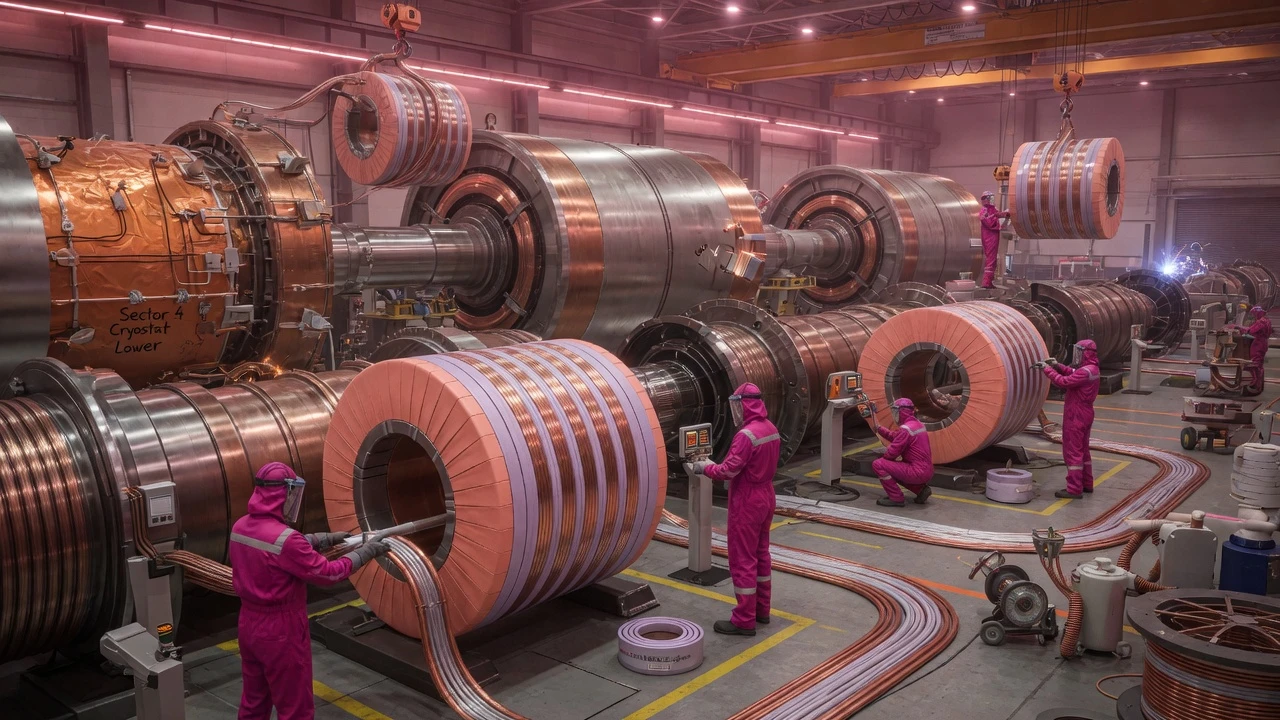
A fusion power plant integrated into the energy grid — the ultimate goal of decades of research. - 10
Understand Fusion's Role in Energy
Fusion will not solve climate change (too late for 2050 net-zero). But it has unique advantages: 1) Unlimited fuel (D from water, Li for T), 2) No carbon emissions, 3) No long-lived radioactive waste (low-level, ~100 year decay), 4) No meltdown risk (passive safety), 5) Firm power (24/7, not intermittent), 6) High energy density (1 gram D-T = 8 tons of coal). Role: baseload clean power for the 22nd century, complementing renewables and fission. Fusion + renewables + storage + fission = a fully decarbonized grid. Fusion is the long-term insurance policy for civilization.
Tip: Fusion is not competing with renewables — it complements them. Renewables (solar, wind) are cheap and fast to deploy but intermittent. Fusion provides firm, clean baseload power when the sun doesn't shine and wind doesn't blow. A decarbonized grid needs both: renewables for bulk energy, fusion/fission for reliability. Fusion's value is in being clean, firm, and fuel-unlimited — a unique combination. - 11
Project the Commercial Timeline
Realistic timeline: 2027 — CFS SPARC Q>1 (first private fusion). 2034 — ITER first plasma. 2039-2042 — ITER D-T, Q=10. 2035-2040 — CFS ARC (first private power plant, if successful). 2040-2045 — Materials qualified (IFMIF/DONES). 2045-2050 — First DEMO net electricity (EU or China). 2050-2055 — DEMO tritium self-sufficient. 2055-2065 — First commercial plants. 2065-2080 — Fusion scale-up. Fusion contributes to the grid starting ~2050, significant by 2070, dominant by 2100. This is a 100-year endeavor from concept to commercial.
Warning: Every fusion timeline in history has been wrong — always optimistic. ITER: 2016 → 2034 (18 years late). NIF ignition: 2012 → 2022 (10 years late). Assume 5-10 year delays on every milestone. Realistic commercial fusion: 2060-2070, not 2040. Plan for fusion as a 22nd century technology, with fission and renewables carrying the 21st.
Summary
The path from Q>1 to commercial fusion: scientific breakeven (NIF 2022) → engineering breakeven (CFS 2027, ITER 2039) → tritium self-sufficiency (DEMO 2045-2050) → net electricity (DEMO 2045-2055) → commercial plants (2055-2065). Key challenges: tritium breeding (TBR>1.05, never demonstrated), steady-state operation (current drive, particle exhaust), plant availability (>70%, remote maintenance), materials qualification (IFMIF/DONES ~2030), and economics (LCOE $50-100/MWh target). Private (CFS) is faster to Q>1; public (ITER) validates physics and materials. Realistic commercial fusion: 2060-2070. Fusion is a 22nd century technology — too late for climate but essential for long-term civilization.
Frequently Asked Questions
Realistic: first net electricity ~2045-2050 (DEMO). First commercial plant ~2055-2065. Significant grid contribution ~2070. Fusion is too late for 2050 climate goals but essential for long-term clean energy. Every historical fusion timeline has been 5-10 years optimistic — plan for 2060-2070 for commercial fusion.
Scientific breakeven (Q>1): fusion energy exceeds heating energy delivered to the plasma. NIF achieved this (Q=1.5, 2022). Engineering breakeven: fusion energy exceeds total facility energy (magnets, cryogenics, lasers). Requires Q>5-10. Not yet achieved. CFS SPARC targets this by 2027. Net electricity requires Q>20-50.
Global tritium supply is ~25 kg and declining. A fusion power plant needs ~1 kg/day — must breed its own from lithium using fusion neutrons (TBR>1.05). If TBR<1, the plant runs out of fuel and shuts down. TBR has been calculated but never demonstrated at fusion-relevant neutron flux. This is the single most critical uncertainty for fusion energy.
CFS is most credible — demonstrated 20T HTS magnets, MIT physics basis, $2B+ funding. SPARC Q>1 by 2027 is plausible. An ARC power plant by 2035-2040 is ambitious but possible. However, CFS must still solve tritium breeding, materials, and steady-state — challenges ITER is designed to address. A hybrid public+private approach is most likely to succeed.
Test Your Knowledge
1. What is required for net electricity from fusion?
Net electricity requires Q>20-50. Thermal-to-electric conversion is ~35% efficient, and recirculating power (magnets, heating, tritium plant) consumes 30-40% of gross output. So Q=10 (ITER) produces no net electricity. DEMO targets Q>20-40 for net grid power.
2. What is the tritium breeding ratio (TBR) needed for self-sufficiency?
TBR > 1.05 — breed 5% more tritium than consumed. The margin covers decay losses, permeation, inventory holdup, and measurement uncertainty. If TBR < 1, the reactor runs out of fuel. TBR has never been demonstrated at full power — a critical uncertainty for DEMO.
3. What is the realistic timeline for commercial fusion power?
Every fusion timeline has been 5-10 years optimistic. ITER: 2016 → 2034. NIF: 2012 → 2022. Realistic: first net electricity ~2045-2050, first commercial plant ~2055-2065. Fusion is a 22nd century technology that arrives too late for climate goals but is essential for long-term energy.